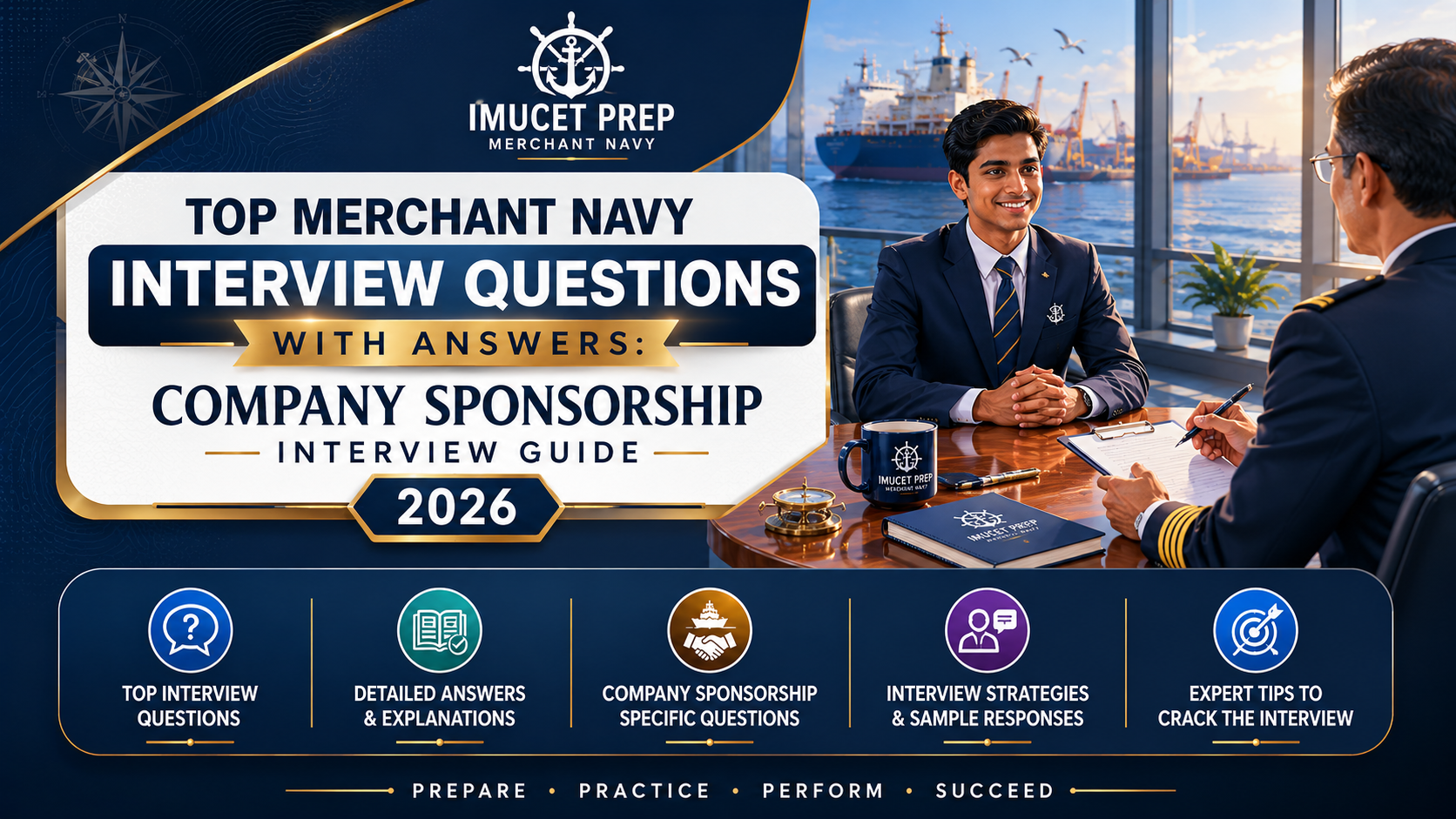
Top Merchant Navy Interview Questions with Answers: Company Sponsorship Interview Guide 2026
Cracking the IMU CET exam is your first victory, but the sponsorship interview is where your maritime dreams truly take flight.
Over 10,000 students appear for IMU CET annually, but only the top performers who excel in both the written exam AND the sponsorship interview secure positions with leading shipping companies like Samundra, Fleet Ship Management, Tolani, TORM, and Great Eastern.
According to industry data, approximately 40% of students clear the IMU CET but fail to secure sponsorship due to poor interview preparation. The difference between a candidate who gets selected and one who doesn’t often comes down to how well they answer merchant navy interview questions.
In this comprehensive guide, we’ll cover:
- ✅ 20+ most common merchant navy interview questions
- ✅ Expert model answers that impress interviewers
- ✅ Company-specific interview questions
- ✅ Body language and communication tips
- ✅ Mock interview strategy
- ✅ Common mistakes to avoid
Let’s dive in.
Understanding the Merchant Navy Sponsorship Interview
Before we get into specific interview questions, let’s understand what shipping companies are really looking for.
What is the Sponsorship Interview?
After qualifying for IMU CET and meeting the medical fitness requirements, candidates are called for sponsorship interviews by various shipping companies. These interviews assess not just your technical knowledge, but your personality, communication skills, mental toughness, and ability to work under pressure.
Why Do Companies Conduct These Interviews?
Shipping companies invest significantly in cadet training, so they need to ensure they’re selecting the right candidates. They’re looking for:
- Technical Knowledge: Understanding of maritime concepts
- Problem-Solving Skills: How you approach challenges
- Teamwork Ability: Can you work in an isolated environment?
- Communication: Clear English and articulation
- Mental Resilience: Can you handle stress and separation from family?
- Commitment: Are you serious about this career?
Interview Duration & Format
- Duration: 15-30 minutes (usually single round)
- Interview Panel: 2-3 senior officers/HR personnel
- Questions: Mix of technical, situational, and personal questions
Part 1: General Merchant Navy Interview Questions & Answers
These are questions asked by almost all shipping companies. Master these first.
- “Tell us about yourself. Why do you want to join the merchant navy?”
What They’re Looking For:
- Clarity of purpose
- Communication skills
- Passion for maritime industry
Model Answer: “Good morning/afternoon. My name is [Name], and I come from [City]. I’ve always been fascinated by the sea since childhood. My father is/was in [relevant field], which further inspired me. After completing my 12th with PCM, I realized that a career in merchant navy combines my passion for travel, engineering [or navigation], and working in a global environment. I cleared IMU CET with an AIR of [rank], which validates my academic strength. I understand merchant navy requires discipline, dedication, and the ability to work away from family. I’m committed to this career and ready to give my best. I want to become a [Deck Officer/Marine Engineer] and eventually rise to the position of [Captain/Chief Engineer].”
Key Points:
- Be specific, not vague
- Show genuine interest, not just seeking a job
- Mention family support or inspiration
- Show you understand the challenges
- Have a clear vision of career progression
2. "What do you know about our shipping company?"
What They’re Looking For:
- Research and preparation
- Genuine interest in THEIR company
- Knowledge of their fleet and operations
Model Answer: “[Company Name] is one of the leading global shipping companies with a strong reputation for fleet management and officer training. You operate over [X] vessels across different categories – bulk carriers, tankers, and container ships. I know that your company is known for excellent training programs for cadets and has a strong focus on safety and compliance with international maritime regulations like SOLAS and STCW. Your company has operations in major ports across the world, and I’ve read about your commitment to sustainable shipping practices.”
How to Prepare:
- Visit their official website
- Check their LinkedIn company page
- Read about their recent news/awards
- Note down vessel types they operate
Learn about their safety record
3. "What is the current shipping market condition? What are global shipping challenges?"
What They’re Looking For:
- General awareness of maritime industry
- Knowledge of current events
- Ability to connect global issues to shipping
Model Answer: “The shipping industry currently faces several challenges:
- Decarbonization Pressure: IMO 2030 and 2050 regulations require ships to reduce carbon emissions. This is driving investments in alternative fuels and modern vessels.
- Suez Canal/Geopolitical Issues: Recent geopolitical tensions have disrupted major shipping routes, increasing voyage duration and costs.
- Crew Shortage: The maritime industry faces a significant shortage of qualified officers due to declining interest in maritime careers.
- Supply Chain Disruptions: Post-pandemic, container shortages and port congestion remain challenging.
- Digitalization: Ships are increasingly using IoT, AI, and automation for better efficiency and safety.
As a cadet, I’m aware that I’ll be entering an industry that demands adaptability, continuous learning, and commitment to safety standards.”
How to Prepare:
- Follow maritime industry news (Seatrade, Maritime Journal)
- Subscribe to IMO updates
- Read business sections of newspapers
- Watch maritime YouTube channels
4. "What will you do if you get homesick or depressed while at sea?"
What They’re Looking For:
- Emotional maturity
- Problem-solving approach
- Understanding of maritime challenges
- Realistic assessment of mental resilience
Model Answer: “I understand that being away from family for 9-10 months is challenging. To cope with this, I’ve already started preparing mentally. I plan to:
- Stay Connected: Use available communication systems onboard to speak with family regularly.
- Maintain Physical Activity: Regular exercise helps manage stress and maintains fitness.
- Build Strong Relationships: Bonding with fellow officers and crew creates a supportive environment onboard.
- Pursue Hobbies: Reading, writing, or other hobbies help pass time constructively.
- Seek Support: If needed, I won’t hesitate to speak with senior officers or the ship’s captain, as they have experience in handling such situations.
- Professional Development: I’ll use sea time to enhance my maritime knowledge and skills.
I’m fully aware of the challenges and have spoken with working officers who have shared their experiences. This has given me confidence that with the right attitude and preparation, I can handle the emotional demands of this career.”
Important Note:
- Be honest but positive
- Show you’ve thought about it
- Don’t say “I won’t get homesick” (unrealistic)
Demonstrate maturity and coping mechanisms
5. "What is the difference between a Deck Officer and an Engineer Officer?"
What They’re Looking For:
- Basic maritime knowledge
- Clear understanding of roles
Model Answer (For Deck Officer Aspirants): “Deck Officers are responsible for navigation, safety, and cargo operations on deck. We navigate the ship, maintain stability, manage lifeboats, handle cargo operations, and ensure compliance with international maritime regulations.
Engineering Officers maintain the ship’s propulsion system and other machinery. They work in the engine room and are responsible for the ship’s mechanical and electrical systems.
Both roles are equally important. A ship cannot function without either department. While Deck Officers focus on ‘where and how the ship sails,’ Engineers focus on ‘keeping the ship running.'”
Model Answer (For Marine Engineer Aspirants): “As a Marine Engineer, I’ll be responsible for maintaining all mechanical and electrical systems of the ship. We troubleshoot engine problems, manage fuel consumption, and ensure the ship’s propulsion system runs smoothly. Deck Officers, on the other hand, focus on navigation and cargo operations. Both are critical but require different skill sets. I’m interested in [Engineering] because I have a strong technical background in [Physics/Mechanics] and enjoy problem-solving related to machinery and systems.
6. "How would you handle a conflict with a senior officer at sea?"
What They’re Looking For:
- Maturity and professionalism
- Respect for hierarchy
- Problem-solving ability
- Communication skills
Model Answer: “I understand that the maritime industry operates on a strict hierarchy and chain of command. If I had a disagreement with a senior officer, I would:
- Stay Professional: Never argue or speak disrespectfully to a senior officer.
- Listen First: Understand the senior officer’s perspective fully before responding.
- Accept Instructions: Follow the officer’s orders without hesitation, even if I initially disagreed.
- Seek Clarification Later: Once the immediate situation is handled, I could respectfully ask for an explanation in private.
- Use Proper Channels: If the issue persists, I would approach the Chief Officer or Captain through the proper chain of command.
- Avoid Escalation: I would never go directly to management or complain to other crew members.
The key is to maintain discipline and respect while expressing concerns through appropriate channels.”
7. "What is STCW and why is it important?"
What They’re Looking For:
- Knowledge of maritime regulations
- Understanding of safety standards
Model Answer: “STCW stands for ‘Standards of Training, Certification and Watchkeeping for Seafarers.’ It’s an international convention established by the IMO (International Maritime Organization) that sets minimum training, certification, and watchkeeping standards for seafarers.
STCW is important because it:
- Ensures all seafarers have minimum competency levels
- Establishes standards for bridge procedures and engine room operations
- Mandates safety training including fire-fighting, first aid, and survival
- Promotes consistency in maritime practices globally
- Protects seafarers’ rights and well-being
As an officer, I’ll need to comply with STCW requirements throughout my career, including regular certifications and training renewals.”
8. "Have you visited a ship? What do you know about ship operations?"
What They’re Looking For:
- Practical knowledge and interest
- Effort to learn beyond textbooks
Model Answer (If You’ve Visited a Ship): “Yes, I had the opportunity to visit [Ship Name/Type]. During the visit, I observed:
- The bridge layout and navigation equipment
- Engine room machinery and control systems
- Living quarters and crew facilities
- Safety equipment including lifeboats
- The strict protocol and discipline maintained onboard
What impressed me most was how systematic everything is. Every procedure has a reason, and every crew member has specific responsibilities. This visit confirmed my commitment to this career.”
Model Answer (If You Haven’t): “I haven’t personally visited a ship yet, but I’ve done extensive research through:
- Maritime documentaries and YouTube channels
- Interviews with working officers
- Ship familiarization courses
- Reading maritime publications
I understand that modern ships operate with advanced automation, GPS navigation, weather routing systems, and integrated bridge systems. Safety is paramount, and every operation follows strict international protocols. I’m eager to gain hands-on experience once I join as a cadet.”
Pro Tip:
- If possible, visit a ship before your interview (many companies appreciate this)
Ask the company if they can arrange a ship visit
9. "What is ship stability? Why is it critical?"
What They’re Looking For:
- Technical knowledge (especially for Deck Officers)
- Understanding of critical maritime concept
Model Answer: “Ship stability refers to the ship’s ability to return to its upright position after being heeled (tilted) by external forces like waves or wind.
It’s critical because:
- Safety: Poor stability can lead to capsizing, especially in rough seas.
- Cargo Operations: Improper loading affects the ship’s center of gravity and stability.
- Operational Efficiency: A stable ship performs better and consumes less fuel.
- Regulatory Compliance: Ships must meet international stability standards (IMO regulations).
As a Deck Officer, I’ll be responsible for maintaining proper stability by ensuring correct cargo loading, ballast water management, and weight distribution. During my training, I’ll learn to calculate stability curves and make real-time adjustments.”
10. "What are your strengths and weaknesses?"
What They’re Looking For:
- Self-awareness
- Honesty
- Focus on improvement
Model Answer:
Strengths: “My key strengths are:
- Technical Aptitude: I’ve consistently scored well in Physics and Mathematics, which are crucial for maritime operations.
- Communication Skills: I can articulate ideas clearly and listen actively to others.
- Problem-Solving: I approach challenges systematically and don’t give up easily.
- Discipline: I follow rules and procedures diligently, which is essential in the maritime industry.
- Adaptability: I’m open to learning and adjusting to new environments.”
Weaknesses: “I’m not perfect, and I’m aware of areas where I need to improve:
- Initial Nervousness: I sometimes get nervous in new situations, but I’ve been working on it through mock interviews and speaking in groups.
- Perfectionism: I sometimes spend too much time perfecting details, but I’m learning to balance quality with efficiency.
- Time Management: I’m working on managing multiple tasks simultaneously, and I’ve started using planning tools to improve this.”
Important:
- Always pair a weakness with an improvement strategy
- Don’t mention critical weaknesses (e.g., “I can’t handle pressure”)
- Keep it real and relatable
Part 2: Company-Specific Interview Questions
Different shipping companies have slightly different focuses. Here are company-specific questions you might face:
For Samundra Institute Sponsorship:
Q: “Why should we sponsor you specifically?”
Model Answer: “I’ve researched Samundra extensively and am impressed by your world-class training infrastructure and global network of training ships. Your cadet program has one of the best success rates, and I believe the environment at Samundra will help me develop into a competent and responsible officer. I’m committed to not just completing the course but excelling in it and becoming a valuable asset to your organization.”
For Fleet Ship Management Sponsorship:
Q: “Fleet has a reputation for safety. Tell us about your commitment to safety.”
Model Answer: “Safety is non-negotiable in the maritime industry. I understand that a single mistake can have catastrophic consequences. My commitment to safety includes:
- Always following procedures, even if they seem time-consuming
- Reporting near-misses and hazards immediately
- Maintaining equipment properly
- Continuously learning and staying updated on safety standards
- Never compromising on safety for convenience
I believe that a strong safety culture starts with individuals taking responsibility, and I’m committed to being that responsible officer.”
For Tolani Sponsorship:
Q: “Tolani values environmental responsibility. What’s your view on sustainable shipping?”
Model Answer: “Environmental sustainability is critical for the maritime industry’s future. Tolani’s commitment to green shipping through modern vessels, alternative fuels, and emission reduction aligns with global IMO regulations and environmental responsibility.
As an officer, I’ll support sustainable practices by:
- Operating the ship efficiently to reduce fuel consumption
- Proper waste management onboard
- Complying with MARPOL regulations
- Supporting investments in cleaner technologies
- Advocating for environmental awareness among crew”
For TORM Sponsorship:
Q: “TORM operates primarily tankers. What do you know about tanker operations?”
Model Answer: “Tanker operations are specialized and require strict adherence to safety and environmental protocols. Tankers transport cargo like crude oil, petroleum products, and chemicals – all hazardous materials. Key points about tanker operations include:
- Strict cargo handling procedures
- Inert gas systems to prevent explosions
- SOLAS and MARPOL compliance
- Specialized loading/unloading procedures
- Environmental protection measures
I understand that tanker operations demand heightened safety standards, and I’m fully prepared to meet these demanding requirements.”
For Great Eastern Shipping:
Q: “Tell us about your leadership qualities.”
Model Answer: “Leadership in the maritime industry is about responsibility, decision-making under pressure, and leading by example. My leadership qualities include:
- Integrity: I believe in doing the right thing, even when no one is watching.
- Decision-Making: I gather information, consult when needed, and make timely decisions.
- Communication: I ensure team members understand objectives and feel valued.
- Resilience: I face challenges calmly and find solutions.
During my cadet training, I plan to develop these qualities further and eventually take on senior positions like Captain or Chief Officer.”
Part 3: Technical Questions for Deck Officers
If you’re pursuing a Deck Officer career, expect these technical questions:
- “What is the function of the Rudder in a ship?”
Answer: “The rudder is a control surface at the stern of the ship that changes the ship’s direction. When the rudder is turned, it creates a pressure differential in the water, causing the ship’s bow to turn. The rudder is controlled from the bridge using the wheel or joystick, and its position is indicated by the rudder angle indicator. Modern ships have automated rudder systems for better maneuverability.”
12. "Explain the Ballast System and why it's important."
Answer: “The ballast system is used to maintain the ship’s stability and trim. When the ship is empty or needs to remain stable, ballast water is pumped into special tanks. The ballast system includes:
- Ballast tanks: Located in the hull
- Pumps: To fill/drain ballast water
- Valves: To control water flow
- Piping: Distribution network
Importance:
- Maintains ship stability and trim
- Increases draft to reduce fuel consumption when traveling empty
- Improves maneuverability
- Essential for safe ship operations
However, ballast water can transfer invasive species, so the Ballast Water Management Convention regulates ballast water treatment.”
13. "What is the purpose of the Plimsoll Line (Load Line)?"
Answer: “The Plimsoll Line indicates the maximum depth to which a ship can be loaded. It’s a set of horizontal lines marked on the ship’s hull that show different draft levels for different water densities and seasons:
- Summer (S): Maximum safe draft in summer
- Winter (W): Lower draft for colder, heavier water
- Tropical (T): Higher draft in warm water
- Fresh Water (F): Highest draft in fresh water
This prevents overloading, which could compromise the ship’s stability and safety. It’s a legal requirement under SOLAS.”
Part 4: Technical Questions for Marine Engineers
- “What are the main types of diesel engines used in ships?”
Answer: “Modern ships primarily use slow-speed and medium-speed diesel engines:
- Slow-Speed Diesel Engines (2-stroke):
- Directly coupled to the propeller
- Highly fuel-efficient
- Used in large cargo ships
- Lower RPM (100-200)
- Medium-Speed Diesel Engines (4-stroke):
- Used in smaller vessels
- Higher RPM (300-3000)
- More flexible for maneuverability
- Used when multiple generators are needed
I prefer [select one] because of its efficiency and reliability characteristics.”
15. "Explain the Bunker Management System."
Answer: “Bunker refers to fuel oil used by the ship’s engines. Bunker management includes:
- Calculating fuel consumption based on distance and engine power
- Ordering appropriate quantities at major ports
- Quality testing of bunker fuel
- Storage in designated tanks
- Proper handling to avoid contamination
Effective bunker management helps:
- Optimize fuel costs
- Ensure uninterrupted ship operations
- Maintain environmental compliance
Improve the ship’s profitability”
Part 5: Common Mistakes in Merchant Navy Interviews (What NOT to Do)
❌ Mistake 1: Being Overconfident or Arrogant
“It’s a simple question, I know this…” Impact: Negative impression
Fix: Be humble and respectful even for simple questions.
❌ Mistake 2: Not Making Eye Contact
Impact: Appears untrustworthy or nervous
Fix: Maintain steady eye contact with the interviewer.
❌ Mistake 3: Poor Body Language
- Slouching
- Fidgeting
- Crossing arms
Fix: Sit straight, hands visible, open posture.
❌ Mistake 4: Memorized Answers That Sound Robotic
Impact: Appears unprepared and insincere
Fix: Practice answers until they’re natural, not memorized.
❌ Mistake 5: Negative Comments About Merchant Navy
“I know the salary is low…” or “I’ve heard it’s a tough life…” Impact: Raises doubt about your commitment
Fix: Focus on positive aspects; acknowledge challenges realistically.
❌ Mistake 6: Being Unprepared About the Company
“Um, I’m not sure what ships your company operates…” Impact: Shows lack of interest and preparation
Fix: Research thoroughly before every interview.
❌ Mistake 7: Interrupting the Interviewer
Impact: Appears disrespectful and unprofessional
Fix: Listen fully before responding.
❌ Mistake 8: Not Asking Questions at the End
When interviewer asks “Do you have any questions for us?” Saying: “No, I think you’ve covered everything.” Impact: Appears disinterested
Fix: Ask 2-3 thoughtful questions about:
- Training programs
- Career progression
- Company’s sustainability initiatives
- Onboarding process for cadets
Part 6: Expert Interview Tips and Strategies
Before the Interview
- Research Extensively
- Company website, LinkedIn, annual reports
- Their fleet (vessel types, sizes, age)
- Recent news and achievements
- Safety records
- Sustainability initiatives
- Key leadership team members
- Prepare Your Resume/CV
- Keep it concise (1-2 pages)
- Highlight academic achievements
- Mention any maritime exposure (ship visits, internships, seminars)
- Include certifications (First Aid, swimming, etc.)
- Practice Mock Interviews
- Use friends or family members as mock interviewers
- Record yourself and watch playback
- Identify areas to improve (pace, pronunciation, body language)
- Practice with IMUCET Prep’s mock interview sessions
- Plan Your Route
- Know the interview venue location
- Plan to arrive 15-20 minutes early
- Don’t arrive too early (appears over-anxious)
- Arrange transportation to avoid last-minute stress
- Prepare Your Documents
- Original certificates
- Admit card/call letter
- ID proof
- Recent photograph
- Medical certificate
Any awards/recognitions
During the Interview
- First Impression Matters
- Dress formally: Navy/Black Suit, White Shirt, Conservative Tie
- Grooming: Fresh haircut, clean nails, minimal jewelry
- Firm handshake
- Smile warmly
- Communication Strategy
- Speak clearly and at moderate pace
- Avoid fillers like “uh,” “um,” “like”
- Listen fully before responding
- Ask for clarification if you don’t understand a question
- Keep answers concise (45 seconds to 2 minutes)
- Body Language
- Sit straight
- Maintain eye contact (not intense staring)
- Nod while listening
- Hands visible on the table
- Avoid crossing arms
- Answer Strategy
- Pause briefly before answering (shows you’re thinking)
- Provide structured answers (Beginning-Middle-End)
- Use examples from your life
- Connect answers back to the company’s needs
- Handling Difficult Questions
- “Why did you score low in [subject]?” Answer: “I struggled with [topic] initially, but I’ve since strengthened this area by [specific action]. My IMU CET score reflects improved performance.”
- “Are you sure you can handle being away from family?” Answer: “Yes, I’ve considered this thoroughly and made my family understand the requirements. We’re fully supportive.”
- “What if you don’t get selected by any company?” Answer: “While I’m committed to getting selected, if that happens, I’ll pursue [alternative path like DNS, GME] and reappear for sponsorship next year.”
After the Interview
- Thank You Note
- Email within 24 hours
- Personalize it (mention specific discussion point)
- Keep it brief and professional
- Reiterate your interest in the position
- Follow-up
- Don’t contact repeatedly; wait for company’s communication
- If told “we’ll contact you in 2 weeks,” follow up after that period only
Maintain a professional demeanor even if rejected
Conclusion: Your Path Forward
The merchant navy interview is your opportunity to demonstrate that you’re not just academically sound but also mentally prepared, professionally mature, and genuinely passionate about a maritime career.
Remember: ✅ Preparation is key – Research, practice, and mock interviews make a difference ✅ Authenticity matters – Be yourself, not a scripted version ✅ Confidence without arrogance – Show belief in your abilities without being overconfident ✅ Listen and respond – Pay attention to questions and answer what’s asked ✅ Follow up professionally – Your professionalism extends beyond the interview room
The next 3-6 months leading up to your sponsorship interview are crucial. Use this guide to:
- Practice these questions regularly
- Develop your own natural responses (not memorized)
- Research companies thoroughly
- Conduct mock interviews
- Refine your communication skills
- Build your confidence
If you’re serious about securing sponsorship from top shipping companies, IMUCET Prep’s expert counseling and mock interview programs have helped over 10,000 students achieve their merchant navy dreams. Our mentors are working maritime professionals who understand exactly what companies look for.
Ready to Ace Your Sponsorship Interview?
Book a FREE Expert Counseling Session with IMUCET Prep today!
Our counselors will:
- Review your background and strengths
- Conduct a mock interview
- Provide personalized feedback
- Create your interview preparation strategy
- Guide you toward your dream shipping company
After the Interview
Q1: When is the sponsorship interview conducted?
Answer: After you clear the IMU CET written exam and pass the medical fitness test. The timeline varies by company but is usually 1-3 months after these milestones. Companies begin selecting from May/June onwards.
Q2: How many rounds of interviews are there?
Answer: Typically, there’s a single interview round lasting 15-30 minutes. Some companies may conduct group discussions before individual interviews. A few large companies might have two rounds, but this is less common.
Q3: What if I fail the interview the first time?
Answer: Not the end of your maritime career! You can:
- Reappear for sponsorship interviews next year
- Consider alternative routes like DNS (Diploma in Nautical Science) or GME (Graduate Marine Engineering)
- Undergo intensive interview coaching to improve
Many successful officers faced rejections initially.
Q4: Are there separate interviews for Deck Officers and Engineers?
Answer: Yes, generally the company will conduct separate interviews for Deck and Engine departments. You typically choose your department when applying, and the interview questions reflect that choice.
Q5: What questions should I ask the interviewer at the end?
Answer: Ask 2-3 meaningful questions like:
- “Can you describe a typical cadet training program?”
- “What qualities do you think make a successful officer?”
- “What career progression can a cadet expect?”
- “Tell us about your fleet’s modernization efforts.”
- “How does your company support environmental sustainability?”
Avoid:
- “What is the salary?” (Discussed in offer letter)
- “How many leaves do we get?” (Sounds disinterested)
- Questions already covered in the interview
Q6: Can I bring notes or a portfolio to the interview?
Answer: It’s professional to bring:
- A portfolio folder with your documents
- Notepad and pen
However, don’t read from notes during the interview. Your answers should be natural and conversational.
Q7: What if I don't know the answer to a question?
Answer: Don’t lie or make up information. Instead:
- “That’s a great question. Let me think about it for a moment.”
- “I’m not entirely certain, but based on my understanding…”
- “I haven’t studied that particular topic yet, but I’m eager to learn it during training.”
- “Can you rephrase the question?” (If you didn’t understand)
Interviewers respect honesty more than fake answers.
Q8: How important is the interview compared to the IMU CET score?
Answer: Both are crucial. While IMU CET score gets you into the company’s sponsorship interview list, the interview determines if you actually get selected. Many high-scoring candidates lose out due to poor interview performance. Conversely, a candidate with a lower score but excellent interview skills can be selected.
Rough ratio: 50% IMU CET score + 50% Interview performance = Selection
Q9: Do companies prefer experience (ship visits, internships)?
Answer: Yes, it’s a significant advantage. It shows:
- Genuine interest in the career
- Effort to learn beyond textbooks
- Understanding of real maritime operations
If you haven’t had ship exposure, don’t worry—focus on demonstrating your commitment through knowledge and enthusiasm.
Q10: What happens after I'm selected
Answer: Once selected:
- Final medical examination by DG Shipping approved doctor
- Joining formalities (documentation, fee payment)
- Cadet training begins at your assigned maritime institute
- After 5-12 months of training, you’re placed onboard a ship
Your maritime career officially begins!