Merchant Navy for Girls – Can Women Join? Complete Guide 2026

So you’ve been dreaming about a career at sea, travelling the world, earning a handsome salary, and living life on your own terms. But somewhere along the way, someone told you — “Merchant Navy is not for girls.”
Let’s bust that myth right now.
Yes, women can absolutely join the Merchant Navy. And not just in supporting roles — women in India are today working as deck officers, marine engineers, electro-technical officers, and even captains on international vessels.
First Things First — Is Merchant Navy Open for Girls in India?
The simple answer is yes. The Directorate General of Shipping (DG Shipping), which is the government body that regulates maritime careers in India, does not prohibit women from joining the Merchant Navy. There is no law or rule that says merchant navy is only for men.
In fact, the Indian Maritime University (IMU) actively accepts female candidates for its undergraduate and postgraduate programs. Many DG Shipping-approved maritime colleges across India welcome women in their DNS, GME, BME, BNS, and ETO courses.
What has changed in recent years is the attitude of the industry. More and more global shipping companies are actively looking to hire women officers because they bring a different kind of discipline, attention to detail, and communication skill on board. International shipping organisations like the IMO (International Maritime Organization) have been pushing for gender diversity in the maritime sector for over a decade now.
So yes — merchant navy for girls is not just possible, it is a growing career opportunity
What Are the Career Paths Available for Women in Merchant Navy?
This is the question most girls search for, and rightly so. Let me break it down for you clearly.
Deck Officer (Navigation Officer)
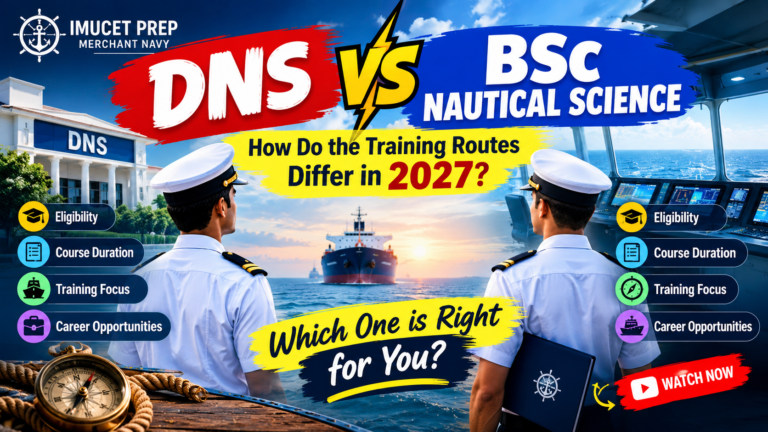
This is one of the most prestigious roles on a ship. A deck officer is responsible for navigating the vessel, maintaining watch on the bridge, and handling cargo operations. Women can join as deck cadets through courses like DNS (Diploma in Nautical Science) or B.Sc. Nautical Science (BNS) and work their way up to become Chief Officer and eventually Captain.
Yes, a woman can become a ship captain. It is not easy — nothing worth having ever is — but it is absolutely achievable.
Marine Engineer
Marine engineering for girls is one of the most in-demand paths right now. Marine engineers are responsible for the engine room, machinery, and all mechanical systems on a ship. You can enter this field through a B.Tech in Marine Engineering (BME) or through the GME (Graduate Marine Engineering) programme if you already have an engineering degree.
Electro-Technical Officer (ETO)
The electro-technical officer manages all electrical systems, navigation electronics, and automation equipment on the ship. This is a fantastic career path for women with a background in electrical or electronics engineering. The demand for ETOs has grown significantly with modern ships becoming more tech-driven.
Hospitality and Catering (Purser / Chief Stewardess)
Cruise ships and some cargo vessels have hospitality departments. Female stewardess careers and purser roles are well-established in the merchant navy world, especially on passenger vessels. If you enjoy hospitality management, this is a legitimate and well-paying path.
Maritime Logistics and Management
Not everyone works directly on ships. Women in maritime logistics work in shipping companies, port authorities, freight forwarding firms, and maritime law. If you have a background in commerce, management, or law, there are onshore careers that are closely tied to the merchant navy industry.
What Are the Educational Qualifications Required?
Let me be direct here because this is where most girls have questions.
For Deck Officer courses (DNS, BNS): You need to have passed Class 12 with Physics, Chemistry, and Mathematics (PCM) from a recognised board. The minimum marks requirement is typically 60% in PCM. You must also appear for the IMU CET entrance exam.
For Marine Engineering (BME, GME): Class 12 with PCM is required for BME. For GME, you need to have completed a B.Tech or B.E. in Mechanical, Electrical, Electronics, or related engineering fields. Again, IMU CET is the entry route for most college-based programs.
For ETO course: A degree or diploma in Electrical or Electronics Engineering is required. The ETO pathway is one of the smoothest entry points for female engineering graduates into the merchant navy.
For GP Rating: If you have passed Class 10, you are eligible for the GP Rating course. This is the entry-level pathway for joining a ship as a crew member. It is open to both boys and girls.
The key thing to remember is that the educational qualifications for women sailors are the same as for men. There is no different standard — you qualify on the same merit.
What Is the Age Limit for Girls Joining Merchant Navy?
| Course | Minimum Age | Maximum Age |
|---|---|---|
| DNS (Diploma in Nautical Science) | 17 years | 25 years |
| BNS (B.Sc. Nautical Science) | 17 years | 25 years |
| BME (B.Tech Marine Engineering) | 17 years | 28 years |
| GME (Graduate Marine Engineering) | 17 years | 28 years |
| GP Rating | 17 years | — |
| ETO (Electro-Technical Officer) | 17 years | 28–30 years |
Note: Some DG Shipping-approved institutes and shipping companies may have slight variations in these limits, so always check the specific admission notification before applying.
The most important takeaway? The age limit for female candidates is exactly the same as for male candidates. There is no gender-based discrimination in eligibility — you compete and qualify on equal terms.
What Are the Medical and Physical Fitness Requirements?
This is probably the most-asked question when it comes to merchant navy for girls. Let me be completely transparent with you.
Vision requirements: You need to have good eyesight. For deck officer roles, a vision standard of 6/6 in both eyes is required, either naturally or with correction (glasses or lenses in some cases). Colour blindness is a disqualifying factor for deck positions because you need to distinguish navigation lights.
Height: There is a minimum height requirement that is typically 150 cm for female candidates in most programs. Some institutes set it at 155 cm. This is lower than what’s required for some armed forces, so it is generally achievable.
General fitness: You should be in good physical health with no chronic conditions that would prevent you from working at sea. Medical tests for girls joining the merchant navy are conducted by DG Shipping-approved doctors and include a full physical examination, blood tests, eye tests, and hearing tests.
Colour vision: Normal colour vision is mandatory for navigation roles. If you have red-green colour blindness, deck officer roles will not be available to you, but engineering and ETO roles may still be accessible.
The physical fitness standards are designed to ensure safety at sea — not to exclude women unfairly. Most healthy young women meet these standards without issue.
Merchant Navy Salary for Female Officers — What Can You Expect?
Let’s talk money, because this is a major reason why merchant navy is worth considering for girls.
Salaries in the merchant navy are paid in US dollars or Euros for most international shipping companies, making them extremely attractive compared to land-based jobs. And the best part? The pay scale for women is exactly the same as for men at the same rank — no gender pay gap here.
Here’s a clear breakdown of what you can expect at each level:
| Rank / Position | Experience Level | Monthly Salary (Approx.) |
|---|---|---|
| Deck Cadet / Trainee Engineer | Fresher (Training Phase) | ₹30,000 – ₹80,000 |
| Third Officer / Junior Engineer | 1–2 Years | ₹1.5 Lakh – ₹3 Lakh |
| Second Officer / Second Engineer | 3–5 Years | ₹3 Lakh – ₹6 Lakh |
| Chief Officer / Chief Engineer | 6–10 Years | ₹6 Lakh – ₹12 Lakh |
| Captain / Master Mariner | 10+ Years | ₹10 Lakh – ₹20 Lakh |
Beyond the Salary — The Complete Package
The monthly figure is just part of the story. Here’s what makes the merchant navy package truly exceptional:
| Benefit | Details |
|---|---|
| 💰 Tax-Free Income | Income exempt from Indian tax if at sea for 183+ days in a financial year |
| 🏠 Accommodation | Free on-board accommodation throughout your contract |
| 🍽️ Meals | All meals provided free of cost on the vessel |
| ✈️ Travel | Travel allowances covered by the shipping company |
| 🏥 Medical Insurance | Full medical coverage during your contract period |
Is Merchant Navy Safe for Girls? Let's Be Honest
This is the question that every parent asks, and it deserves an honest answer.
Life on a ship involves spending months away from home in a relatively small community of crew members. The safety for girls in merchant navy depends significantly on the shipping company and the vessel type.
Here is what you should know:
Reputed international shipping companies have strict codes of conduct and anti-harassment policies. Most modern vessels have HR managers or senior officers responsible for crew welfare. The IMO has guidelines on prevention of harassment and bullying on ships, which certified shipping companies follow.
That said, it would be dishonest to say there are zero challenges. Working on ships as a woman in a historically male-dominated environment can be uncomfortable at times. You will need to be mentally strong, professionally confident, and willing to stand your ground.
The good news is that with each passing year, the culture is changing. More women at senior ranks means better support systems for newcomers. Choosing the right company — one with a clear policy on gender inclusion — makes a significant difference.
Advice from female mariners who have worked at sea: choose your first company carefully, be professional from day one, and never compromise on your boundaries. The sea is as safe as you make it — with the right preparation and mindset.
Challenges for Women in Shipping — And How to Overcome Them
Let’s acknowledge that challenges exist, because pretending otherwise doesn’t help you.
Physical demands: Ships involve physical work. Climbing ladders, handling ropes, working in engine rooms — this requires physical fitness. Regular exercise and strength training before joining will prepare you well.
Long time away from family: Working at sea means contracts of 4 to 6 months at a time, away from home. Work-life balance for women at sea is a real consideration. Many female mariners manage family life successfully with open communication and planning, but it requires a supportive family environment.
Being in a minority: On most ships, you may be the only woman or one of a small number. This can feel isolating. Connecting with online communities of female seafarers and mentors helps enormously.
Social perception: In India, choosing merchant navy as a girl still raises eyebrows in some families and communities. The good news is that a single salary slip from your second year at sea tends to settle most doubts.
These challenges are real but not impossible. Thousands of women globally and a growing number in India have built successful careers at sea.
Scholarships for Girls in Merchant Navy
If you’ve read this far, you’re clearly serious about this career. And you should be — because merchant navy for girls is not just a possibility in 2026, it is a genuinely exciting and rewarding path.
Yes, it requires hard work. Yes, there will be challenges. But the same is true of any career worth having.
The sea doesn’t care about your gender. It cares about your skill, your preparation, and your determination.
If you’re ready to take the first step, start by clearing the IMU CET — and IMUCET Prep is here to make sure you do exactly that. Our experienced faculty, dedicated sponsorship guidance, and proven track record have already helped thousands of students build their maritime careers. We are just as ready to help you.
For More Information
Visit Our Website – IMUCET Prep
Visit us at – Google Business Profile
Frequently Asked Questions
1. How to join the Merchant Navy as a woman?
The process is straightforward. Complete Class 12 with Physics, Chemistry, and Mathematics. Appear for the IMU CET entrance exam (held twice a year). Based on your rank, apply to DG Shipping-approved maritime colleges for courses like DNS, BME, BNS, or ETO. Get a medical fitness certificate from a DG Shipping-approved doctor. Join a pre-sea training program. After completing training and sea time, apply to shipping companies for a job. Coaching institutes like IMUCET Prep can guide you through the sponsorship process, which significantly improves your placement prospects.
2. How to join the Merchant Navy in 2026?
In 2026, the entry route remains through IMU CET for college-based programs or direct sponsorship exams conducted by shipping companies. The IMU CET exam tests candidates on Physics, Chemistry, Mathematics, English, and General Aptitude. Registrations open on the official IMU website. After qualifying the exam and securing admission, you complete your pre-sea training and then sail on ships to accumulate sea time before receiving your Certificate of Competency.
3. Is the Merchant Navy safe for girls?
Merchant navy can be safe for girls if you choose reputed, DG Shipping-approved shipping companies that have clear policies against harassment and prioritise crew welfare. Globally recognised shipping companies follow IMO guidelines on crew safety and conduct. The key is to research the company before signing a contract, connect with other female seafarers for guidance, and approach your career with professional confidence.
4. Is navy a good job for females?
Absolutely yes. The merchant navy offers one of the highest salary packages in India, tax-free income, global exposure, and rapid career growth. For women who are adventurous, disciplined, and willing to work in a non-traditional environment, it is an exceptional career choice. The pay scale is the same as for male colleagues, and the demand for women officers in international shipping is growing every year.