How to Get Merchant Navy Sponsorship (Step-by-Step Process 2026)
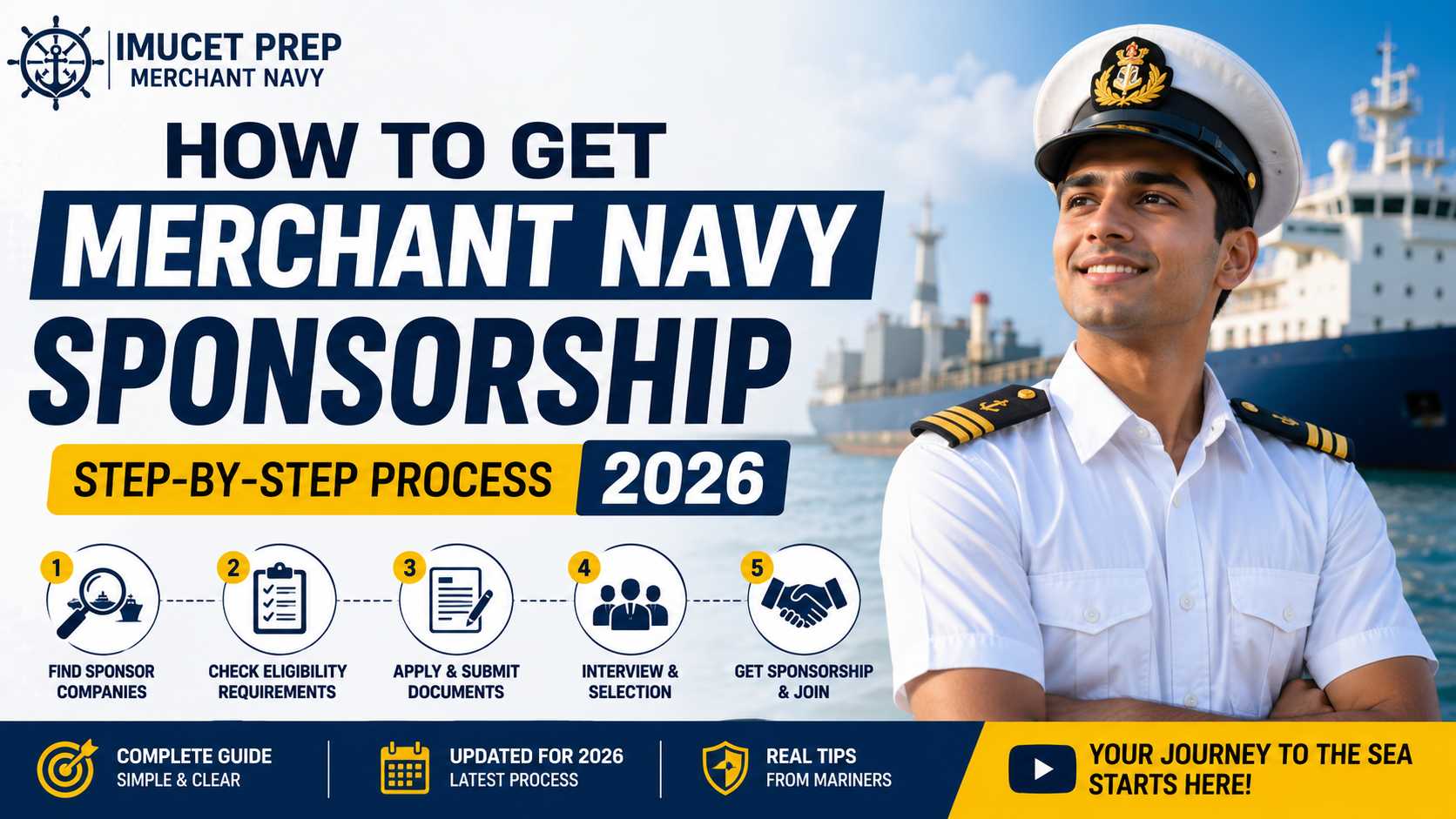
If you’ve qualified IMU CET or are pursuing DNS/BNS/GME, you’ve probably heard this term over and over: merchant navy sponsorship. But what does it actually mean, and how do you get one? Getting merchant navy sponsorship is often the single biggest factor that decides whether your maritime career actually takes off — without it, even a good academic record can leave you stuck on shore. This guide breaks down the entire merchant navy sponsorship process step by step, for 2026.
What is Merchant Navy Sponsorship?
Merchant navy sponsorship means a shipping company officially agrees to fund your training, sea-time, and future employment as a cadet, in exchange for a bond period during which you work for them after qualifying. In simple words, merchant navy sponsorship is your ticket from classroom training to actually sailing on a real ship.
Without sponsorship, cadets often struggle to complete their mandatory sea time, because sea time can only happen on a ship, and ships are operated by shipping companies — which is exactly why merchant navy sponsorship is such a critical checkpoint in your career.
Why is Merchant Navy Sponsorship So Important?
Here’s the honest truth: passing IMU CET is only step one. Without merchant navy sponsorship, you cannot:
- Complete your mandatory sea time as a cadet
- Get access to a real ship for onboard training
- Progress toward your Certificate of Competency (CoC) exams
- Eventually become an officer (3rd Officer, 4th Engineer, etc.)
This is why merchant navy sponsorship is treated as the real gatekeeper of a maritime career — more important, in many ways, than the entrance exam itself.
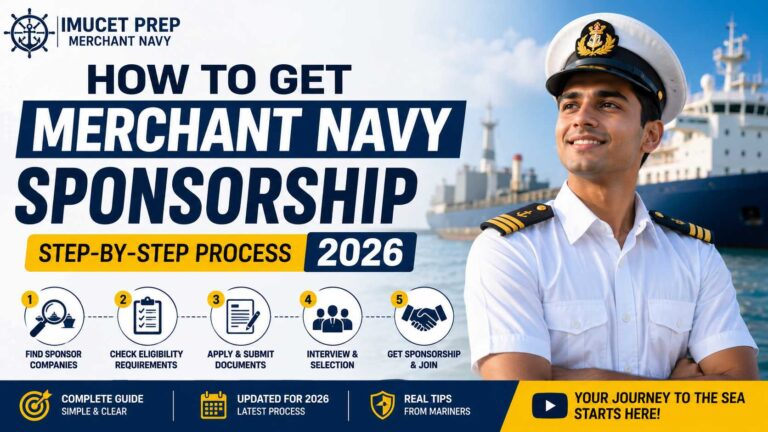
Step-by-Step Process to Get Merchant Navy Sponsorship
Step 1: Qualify IMU CET or an Equivalent Entrance Exam
The first step toward merchant navy sponsorship is clearing IMU CET (for GME, BNS courses) or meeting the academic eligibility for DNS / GP Rating programs. Your IMU CET rank plays a big role in which shipping companies will consider you, since top-tier companies often prefer higher-ranked candidates.
Step 2: Meet Medical Fitness Standards
Before any shipping company grants merchant navy sponsorship, you must clear a medical examination as per DGS (Directorate General of Shipping) guidelines. This includes eyesight standards, height and weight ratios, no major tattoos in visible areas, and overall physical fitness. Failing the medical exam is one of the most common reasons students lose merchant navy sponsorship opportunities, so getting checked early — before you invest in coaching — is smart.
Step 3: Prepare a Strong Application/Profile
Shipping companies offering merchant navy sponsorship typically review your academic scores, IMU CET rank, communication skills, and sometimes a written statement of purpose. A well-prepared, honest, and clear profile increases your chances significantly.
Step 4: Appear for Company-Specific Written Tests
Many shipping companies conduct their own written aptitude and technical tests before offering merchant navy sponsorship, in addition to your IMU CET score. These tests usually cover basic Physics, Mathematics, English, and general reasoning.
Step 5: Clear the Psychometric Test
Almost every shipping company includes a psychometric evaluation as part of the merchant navy sponsorship process. This test measures your decision-making ability, stress handling, teamwork, and situational judgment — all crucial traits for life at sea.
Step 6: Attend the Personal Interview
The final and most decisive stage of merchant navy sponsorship is the personal interview. Companies assess your communication, confidence, genuine interest in a seafaring career, and your understanding of what life on a ship actually involves. This is where many candidates who are academically strong still lose out simply due to lack of preparation for this specific stage.
Step 7: Sign the Sponsorship Agreement (Bond)
Once selected, you sign a formal merchant navy sponsorship agreement, which usually includes a bond period — meaning you commit to working with that company for a set number of years after qualifying, in exchange for their investment in your training and sea time.
Step 8: Begin Pre-Sea Training and Sea Time
After merchant navy sponsorship is confirmed, you begin your structured pre-sea training (if not already completed) followed by actual onboard sea time under that company’s fleet.
Documents Required for Merchant Navy Sponsorship
Keep these ready well in advance, as they are commonly requested during the merchant navy sponsorship process:
- 10th and 12th mark sheets
- IMU CET scorecard/rank letter
- Medical fitness certificate (as per DGS norms)
- Passport (valid for at least the training/sea-time duration)
- Passport-size photographs
- Character certificate from school/college
- PCC (Police Clearance Certificate), if requested
How Many Chances Do You Get for Merchant Navy Sponsorship?
There is no fixed universal limit, but realistically, most candidates should aim to secure merchant navy sponsorship within 1–2 years of completing their qualifying exam or course, since companies generally prefer recent, motivated candidates. The longer the gap between qualifying and getting sponsorship, the harder it can become to explain that gap convincingly in interviews.
Common Reasons Students Fail to Get Merchant Navy Sponsorship
- Poor interview preparation — many students are academically capable but freeze during the personal interview.
- Medical disqualification — often discovered too late, after months of coaching investment.
- Weak communication skills — shipping companies value clear, confident English communication highly.
- Lack of genuine interest — interviewers can usually tell when a candidate doesn’t actually understand or want the seafaring lifestyle.
- Incomplete or delayed documentation — missing paperwork can cause you to lose your slot even after clearing all rounds.
Tips to Improve Your Chances of Merchant Navy Sponsorship
- Get your medical fitness checked before you even start coaching, so there are no surprises later.
- Practice mock interviews specifically designed around merchant navy sponsorship panels, not generic job interviews.
- Work on your spoken English and confidence — this matters more than most students realize.
- Research the specific shipping company you’re applying to — know their fleet type, routes, and values.
- Apply to multiple companies simultaneously rather than waiting for just one response.
Final Thoughts
Getting merchant navy sponsorship is not just about academic marks — it’s a complete process involving medical fitness, psychometric evaluation, interview performance, and paperwork readiness. Understanding each step in advance dramatically improves your chances of getting selected by a good shipping company.
Confused about where to start or which companies are currently offering merchant navy sponsorship? Talk to our expert sponsorship counselors at IMUCET Prep — we guide students through every stage of the process, from medical checks to final interview preparation.
For More Information
Visit Our Website – IMUCET Prep
Frequently Asked Questions
Q1: What is IMU CET sponsorship?
IMU CET sponsorship is when a shipping company funds your training, sea time, and future employment as a cadet after you qualify IMU CET, in exchange for a bond period of service with that company.
Q2: Does IMUCET Prep guarantee sponsorship placement?
IMUCET Prep prepares you for company-specific written tests, psychometric evaluations, and interviews that shipping companies use to select sponsored candidates, giving you the strongest possible chance of placement.
Q3: Do I need to clear IMU CET before applying for sponsorship?
Yes, for GME and BNS courses, a qualifying IMU CET score is generally required before shipping companies will consider you for sponsorship. Some GP Rating and DNS pathways have separate company-specific entry routes.
Q4: How does IMUCET Prep help with the sponsorship process?
We provide company-specific test preparation, psychometric test practice, mock interviews with real sponsorship-style questions, and one-on-one counseling to match you with the right shipping companies based on your profile.
Q5: Is medical fitness checked before or after sponsorship selection?
Medical fitness is usually checked as part of the sponsorship process, often after initial written tests and interviews, so it’s best to get a preliminary check done early — before you invest time in company-specific preparation.