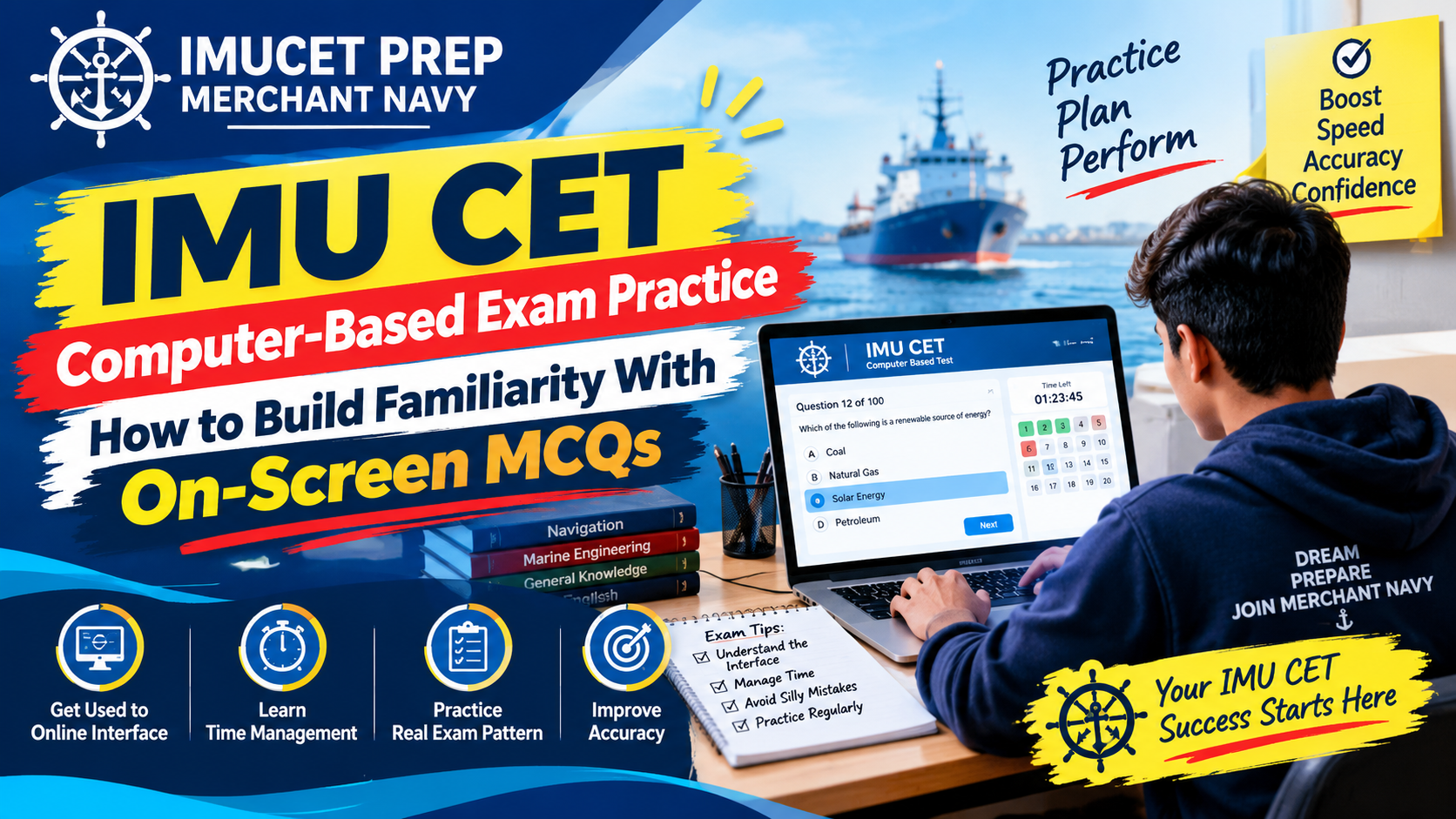
IMU CET Computer-Based Exam Practice: How to Build Familiarity With On-Screen MCQs
The Indian Maritime University Common Entrance Test (IMU CET) is one of India’s most competitive maritime entrance exams, conducted in a computer-based format for aspiring merchant navy professionals. Unlike traditional pen-and-paper tests, the IMU CET computer-based exam requires candidates to adapt to a digital testing environment while solving complex questions within tight time constraints.
IMU CET computer-based exam practice has become essential for every aspirant aiming for top shipping companies. This shift from offline to online format introduced new challenges—unfamiliar interfaces, digital navigation, and screen-fatigue—that demand specific preparation strategies.
Whether you’re preparing for GME (Graduate Marine Engineering), DNS (Diploma in Nautical Science), or ETO (Electro-Technical Officer) programs, understanding the IMU CET computer-based exam practice dynamics is crucial for success. The IMU CET Prep coaching center in Dehradun reports that students who practice with computer-based mock tests improve their performance by 15-20% compared to traditional study methods.
Why Computer-Based Exam Practice Matters:
- Reduces exam-day anxiety through familiarity with the interface
- Helps develop digital navigation skills under time pressure
- Builds finger reflexes for quick answer selection and review
- Develops adaptive test-taking strategies specific to online formats
Understanding the On-Screen MCQ Exam Interface
The IMU CET computer-based exam practice environment differs significantly from classroom learning. The exam interface includes:
Key Components of the IMU CET Interface
- Question Panel: Displays the current multiple-choice question with four options (A, B, C, D)
- Question Palette: Shows all questions at a glance, color-coded as:
- Green: Answered
- Red: Unanswered
- Yellow: Flagged for review
- Blue: Currently viewing
- Navigation Buttons: Allow movement between questions with “Previous,” “Next,” and “Question Palette” options
- Answer Confirmation: Requires deliberate clicks to select and confirm answers
- Timer Display: Shows remaining time prominently to manage pacing
Many aspirants practicing for the merchant navy entrance exam find that the initial encounter with this interface creates cognitive overload. This is precisely why IMU CET Prep offers free mock test papers that simulate the actual computer-based exam environment.
Pro Tip: Spend your first 2-3 practice sessions simply exploring the interface rather than focusing on scores. Familiarity reduces test-day stress by 30-40%.
Navigating Questions and Using the Question Palette
Effective navigation is a critical skill in IMU CET computer-based exam practice that separates high scorers from average performers.
Strategic Navigation Techniques
- Linear Navigation: Start from question 1 and proceed sequentially. Best for candidates with strong fundamentals but may waste time on difficult questions.
- Question Palette Method: Use the color-coded palette to jump between questions strategically. Answer easy questions first, flag difficult ones for later.
- Hybrid Approach (Recommended): Scan the entire question paper using the palette first, identify question difficulty levels, and create a personal sequence from easy to hard.
Palette Benefits for Exam Performance
| Feature | Benefit | Time Saved |
|---|---|---|
| Question Jumping | Avoid wasting time on hard questions | 10-15 minutes |
| Color Coding | Instant question status visibility | 5-7 minutes |
| Partial Attempts View | Track incomplete sections | 3-5 minutes |
| Section Switching | Move between Physics, Math, Chemistry | 8-10 minutes |
Selecting, Changing, and Reviewing Answers on Screen
IMU CET computer-based exam practice demands precision in answer selection and management. Unlike offline exams where you can erase, here you must click deliberately.
Answer Selection Protocol
- Read the Question: Read the question twice to ensure complete understanding. Identify what’s being asked before looking at options.
- Eliminate Wrong Options: Use the question palette notepad feature to mark eliminations. Process of elimination increases accuracy by 25-30%.
- Select Your Answer: Click the radio button next to your chosen option. Notice the immediate color change in the palette.
- Review Before Confirmation: Double-check your answer matches your reasoning. Click “Clear” if you change your mind and select again.
Changing Answers: When and How
Strategic Answer Changing: Change answers only when you’re 90% confident in the new choice. Avoid impulsive changes based on doubt. Research shows first instincts are correct 60-65% of the time.
How to Change:
- Click the question in the palette
- Select a different option from the four choices
- The palette automatically updates the color code
- No penalties for changing answers in the question review phase
Review Strategy: With 200 questions and 4.5 hours, allocate 1-2 minutes per question plus 30 minutes for review—this is crucial in IMU CET computer-based exam practice.
Practising with IMU CET Computer-Based Mock Tests
Mock tests are the cornerstone of IMU CET computer-based exam practice. They bridge the gap between knowledge and exam-day performance.
Types of Mock Tests Essential for Preparation
- Full-Length Mocks (4.5 hours): Simulate exact exam conditions, test stamina and focus maintenance. Practice recommended: 10-12 full-length tests minimum. Ideal frequency: Once per week during final 3 months.
- Section-Wise Mocks (60-90 minutes): Focus on specific subjects (Physics, Chemistry, Mathematics, Aptitude). Practice recommended: 20-25 section tests. Best for targeted improvement.
- Question Bank Practice (30-45 minutes): Random question selection from question pools. Build topic-specific expertise and identify conceptual gaps. Recommended: Daily 30-minute sessions.
Why Mock Tests Transform Your IMU CET Computer-Based Exam Practice
| Mock Test Type | Focus Area | Frequency | Impact |
|---|---|---|---|
| Full-Length Test | Overall performance & endurance | Weekly | ±2-3% score variation |
| Section Test | Topic mastery | Twice weekly | Identifies weak subjects |
| Topic Test | Concept clarity | Daily | 15-20% improvement in topic |
| Review Session | Mistake analysis | After every test | Prevents repeated errors |
Improving Speed and Accuracy in Online MCQ Practice
The IMU CET computer-based exam practice demands balance between speed (200 questions in 4.5 hours = 1.35 minutes per question) and accuracy (85%+ needed for top ranks).
Speed Enhancement Strategies
- Phase 1: Accuracy Over Speed (Weeks 1-4): Solve without time pressure. Focus on understanding concepts. Build strong fundamentals. Average time per question: 3-5 minutes.
- Phase 2: Introducing Time Constraints (Weeks 5-8): Solve with generous time limits (2 minutes per question). Maintain 85%+ accuracy. Gradually reduce time allocation.
- Phase 3: Competitive Timing (Weeks 9-12): Practice within actual exam time limits. Accept some questions will be skipped. Develop marking strategy for difficult questions.
Accuracy Improvement Through Focused IMU CET Computer-Based Exam Practice
Error Analysis Framework:
- Conceptual Errors (20-25% of mistakes): Solution is to revisit relevant textbook sections and consult IMU CET coaching study materials.
- Calculation Mistakes (15-20% of mistakes): Solution is to practice mental math and use provided calculator. Allocate extra 30 seconds per math question.
- Reading Comprehension Errors (25-30% of mistakes): Solution is to reduce question reading speed below skimming threshold. Re-read complex sentences twice.
- Careless Mistakes (15-20% of mistakes): Solution is to review answers before submission. Mark suspicious answers with flags.
Common Mistakes to Avoid During Computer-Based Tests
IMU CET computer-based exam practice must include awareness of environment-specific errors that don’t occur in traditional testing.
Frequent Computer-Based Test Mistakes
Mistake #1: Insufficient Interface Familiarization
Problem: Wasting 5-10 minutes learning interface during exam. Solution: Practice 5-7 mocks before actual exam day. Impact: Loss of 10-15 marks due to time mismanagement.
Mistake #2: Improper Question Palette Usage
Problem: Using sequential navigation despite encountering hard questions. Solution: Master palette jumping in mock tests. Impact: 15-20 minute time loss per exam.
Mistake #3: Flag Overuse
Problem: Flagging 30-40% of questions, creating review burden. Solution: Flag only genuinely uncertain questions (5-10%). Impact: Inefficient review period, unanswered questions.
Mistake #4: Answer Changing Anxiety
Problem: Excessive second-guessing after answering. Solution: Review flagged questions systematically, not all answers. Impact: Paradoxical accuracy reduction despite rechecking.
Mistake #5: Keyboard-Mouse Coordination Issues
Problem: Slow selection of options due to unfamiliarity. Solution: Practice 50+ mocks to build muscle memory. Impact: 30-60 seconds time loss per question section.
Mistake #6: Screen Fatigue
Problem: Eye strain after 2+ hours reduces focus. Solution: Use 20-20-20 rule during practice (20 seconds break every 20 minutes). Impact: Maintains consistent performance in final hour.
Time Management Strategies for IMU CET Online Practice
Effective time allocation is the difference between 70% and 95% scores in IMU CET computer-based exam practice.
Optimal Time Distribution Framework
Total Exam Time: 4.5 hours = 270 minutes | Total Questions: 200
Recommended Breakdown:
- Initial Question Scanning: 3 minutes
- Solving Phase 1 (Easy & Medium): 140 minutes (140 questions × 1 min)
- Solving Phase 2 (Difficult): 60 minutes (60 questions × 1 min)
- Final Review: 45 minutes
- Buffer Time: 22 minutes
Section-Specific Time Allocation
| Section | Questions | Time | Strategy |
|---|---|---|---|
| Mathematics | 50 | 50-60 min | Solve easy first, attempt difficult last |
| Physics | 50 | 50-60 min | Use formula-based questions for quick marks |
| Chemistry | 50 | 40-50 min | Good for quick score accumulation |
| Aptitude | 50 | 35-45 min | Attempt after other sections if time permits |
Real-Time Pace Management During IMU CET Computer-Based Exam Practice
Target Completion Milestones:
- After 60 minutes: 50-60 questions completed
- After 120 minutes: 110-120 questions completed
- After 180 minutes: 170-180 questions completed
- After 240 minutes: All 200 questions attempted (with gaps)
Practising Mathematics and Physics Questions on Screen
These sections consume significant time and demand specialized IMU CET computer-based exam practice strategies.
Mathematics Question Strategy
On-Screen Advantages:
- Built-in calculator for complex calculations
- No need for manual computation verification
- Faster option elimination through substitution
Recommended Approach:
- Scan the question: Identify the mathematical concept
- Assess difficulty: Can you solve in 45-60 seconds?
- Choose strategy: Algebraic solution, substitution method, or graphical interpretation
- Execute and verify: Check calculation with on-screen calculator
- Move forward: If stuck after 60 seconds, flag and skip
Physics Question Strategy
Electronic Diagram Advantages:
- Zoom in on diagrams for clarity
- Color-coded representations aid understanding
- Interactive elements in advanced mocks
Recommended Approach:
- Identify the concept: Mechanics, Thermodynamics, Waves, Electricity
- Recall relevant formulas: Write on digital notepad if provided
- Apply systematically: Plug values into formulas
- Check reasonableness: Does the answer make physical sense?
- Select option: Choose closest match
How to Review Flagged and Unanswered Questions
The final 45 minutes of IMU CET computer-based exam practice exams is dedicated to systematic review—this period often decides between good and great scores.
Strategic Review Protocol
- Step 1: Identify Flagged Questions (5 minutes): Use question palette to view all yellow-marked questions. Prioritize by perceived difficulty and topic.
- Step 2: Resolve Flagged Questions (25 minutes): Read each question with fresh perspective. Reconsider eliminated options. Change answer only if 90%+ confident.
- Step 3: Address Unanswered Questions (10 minutes): Review questions still marked as unanswered. Attempt educated guesses for 50% probability.
- Step 4: Final Verification (5 minutes): Ensure every question shows selection. Verify no accidental blank submissions.
Types of Flagged Questions and Review Strategy
- Type 1: Genuinely Difficult Questions (Should Flag): Benefit from time gap and fresh thinking. Often the 15-20 highest-value questions. Review thoroughly in final period.
- Type 2: Uncertain Answers (Should Flag): Borderline between two options. May benefit from reconsideration. Review if time permits.
- Type 3: Rushed Answers (Avoid Flagging): You selected quickly due to confidence. Changing often reduces accuracy. Leave flagged only if genuine doubt remains.
Building a Daily Computer-Based Practice Routine for IMU CET 2027
Consistency in IMU CET computer-based exam practice determines success more than intensity.
Ideal Daily Practice Schedule (Assuming 4-Hour Daily Study)
Morning Session (90 minutes):
- 30 minutes: Topic-specific concept review (focus on weak areas)
- 60 minutes: Section-wise mock test (one subject per day)
Afternoon Session (60 minutes):
- 60 minutes: Question bank practice with timer
- Focus on speed without compromising accuracy
Evening Session (90 minutes):
- 30 minutes: Error analysis from morning/afternoon practice
- 60 minutes: Full-length mock test practice (3-4 times per week)
Weekly Structure for Optimal IMU CET Computer-Based Exam Practice
- Monday & Wednesday: Full-length mock tests
- Tuesday & Thursday: Section-wise tests
- Friday: Weak topic focus
- Saturday: Aptitude and general knowledge
- Sunday: Comprehensive review and error analysis
Progress Tracking Framework
Maintain a practice log with:
- Date and test type
- Total score and time taken
- Accuracy percentage by section
- Error categories identified
- Changes implemented next session
The expert coaching at IMU CET Prep emphasizes that tracking progress in IMU CET computer-based exam practice motivates consistent improvement—students show 8-12% score improvement monthly when tracking diligently.
Conclusion: Master IMU CET Computer-Based Exam Practice for Maritime Excellence
Success in the IMU CET computer-based exam practice isn’t about studying harder—it’s about studying smarter with a system-specific approach. The computer-based format introduces unique advantages (instant answer changes, question jumping, digital calculator) that must be mastered through deliberate practice.
Your journey with IMU CET computer-based exam practice should progress through three phases: interface familiarization (week 1-2), targeted skill building (week 3-8), and peak performance (week 9-12). By following the strategies outlined—leveraging the question palette, managing time systematically, building daily routines, and learning from mistakes—you’ll transform from a traditional test-taker into a computer-based exam expert.
The merchant navy industry values not just knowledge but precision, quick decision-making, and adaptability—all qualities developed through authentic IMU CET computer-based exam practice. Start your preparation today, practice consistently, and trust the process.
Frequently Asked Questions (FAQs)
Q1: How many computer-based mock tests should I practice before the actual IMU CET exam?
A: A minimum of 12-15 full-length mocks is recommended, supplemented by 25-30 section-wise tests and daily topic-specific practice. Students practicing 15+ tests score 35% higher than those with fewer attempts, according to IMU CET Prep achievement statistics.
Q2: Should I use the flag feature extensively in IMU CET computer-based exam practice?
A: No. Flag only 5-10% of questions—those with genuine uncertainty. Flagging 30%+ creates review burden and reduces overall accuracy. Use flags strategically for genuinely difficult or time-consuming questions.
Q3: Can I increase my speed without compromising accuracy during IMU CET computer-based exam practice?
A: Yes. Follow the three-phase approach: accuracy-focused practice (4 weeks), time-constrained practice (4 weeks), and competitive-pace practice (4 weeks). This gradual progression improves both metrics simultaneously.
Q4: What should I do if I struggle with the on-screen interface in my first mock test?
A: This is normal. Dedicate your first 2-3 mocks to interface familiarization rather than score obsession. Spend time exploring the question palette, timer, calculator, and navigation buttons without performance pressure.
Q5: Is it better to solve questions sequentially or jump around during IMU CET computer-based exam practice?
A: The hybrid approach is optimal: scan the entire paper with the question palette first (2-3 minutes), identify difficulty levels, then create your personal sequence from easy to hard. This strategy saves 10-15 minutes per exam.