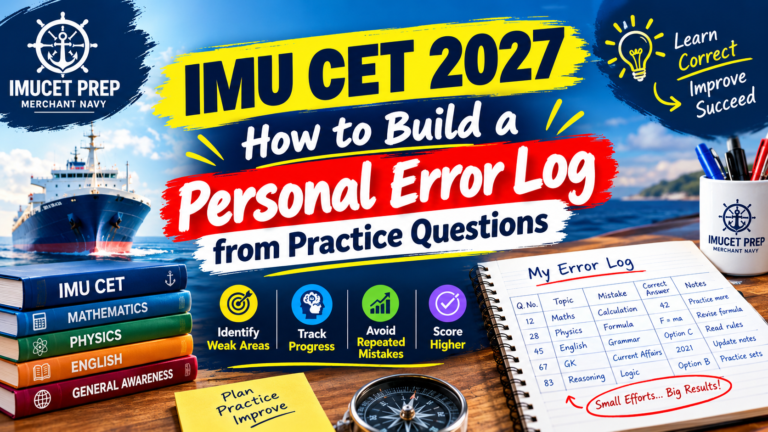
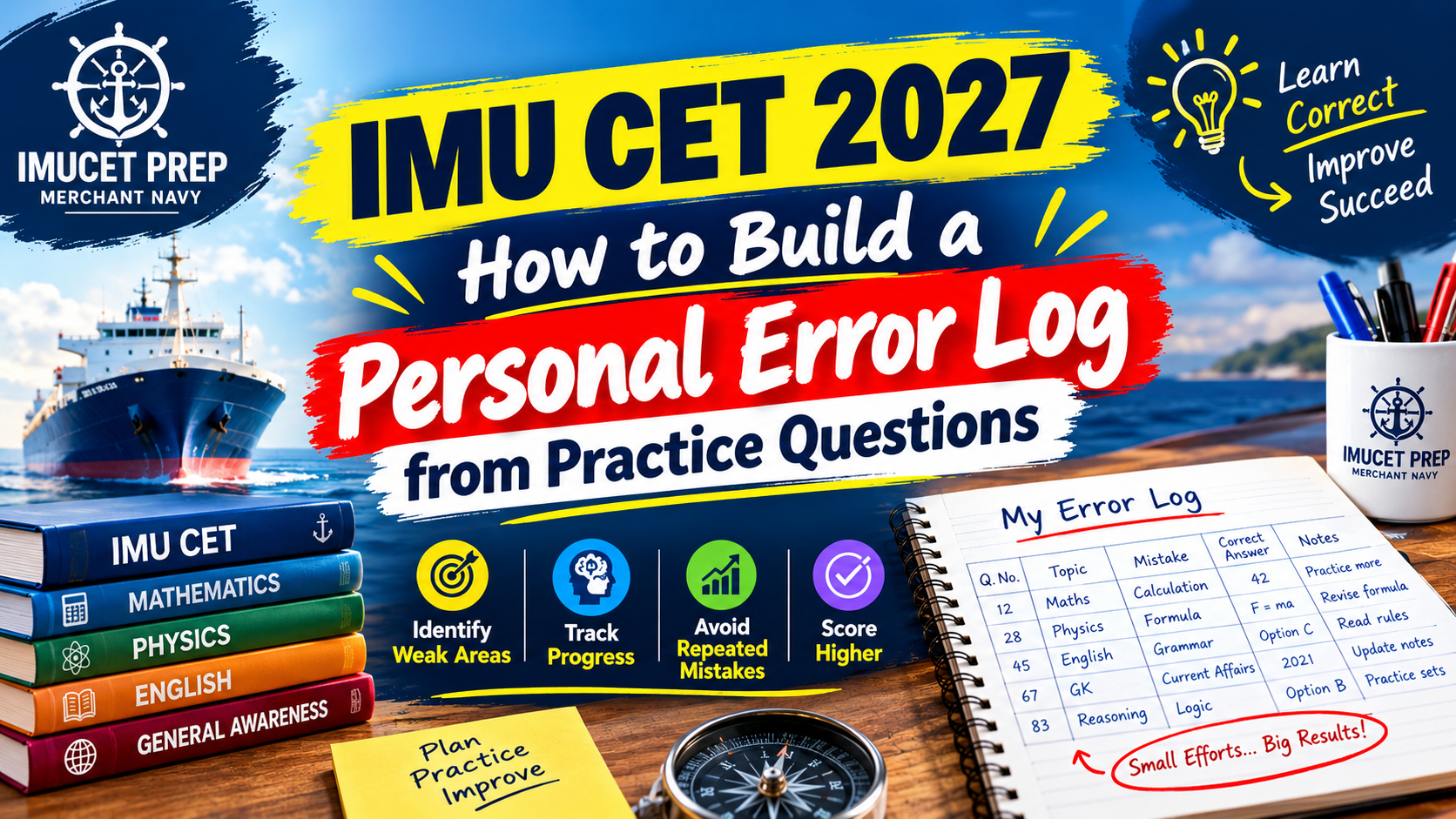
IMU CET 2027: How to Build a Personal Error Log from Practice Questions
Preparing for the Indian Maritime University Common Entrance Test (IMU CET) requires more than just solving practice questions repeatedly. The real breakthrough comes when you understand why you’re making mistakes and how to prevent them in the future. This is where a personal error log becomes your most powerful study tool.
An error log isn’t just a list of wrong answers—it’s a strategic document that transforms your preparation into a systematic learning process. Whether you’re aiming for sponsorship through companies or planning to join one of IMU’s prestigious programs, mastering IMU CET mistake analysis will significantly improve your performance.
According to educational research, students who maintain detailed error logs improve their test scores by 15-25%. In competitive exams like IMU CET, this improvement can mean the difference between selection and rejection.
What Is an IMU CET Practice Error Log?
An error log is a structured document where you record every mistake you make while solving practice questions. It goes beyond simply marking an answer as wrong—it requires you to analyze the problem, understand the mistake, and document the learning.
Key Components of an Error Log:
- Question Details: Topic, difficulty level, source
- Your Answer vs. Correct Answer: What you answered and what was correct
- Error Classification: Type of mistake (conceptual, calculation, misunderstanding)
- Root Cause Analysis: Why the mistake occurred
- Solution & Learning: How to solve it correctly next time
- Revision Schedule: When to review this topic again
The beauty of maintaining an IMU CET practice error log is that it becomes a personalized study material tailored specifically to your weak areas. Unlike generic study guides, your error log addresses your unique learning gaps.
Why Tracking Mistakes Improves Exam Preparation
Understanding the psychology behind error tracking is crucial. When you encounter a mistake, your brain creates a learning opportunity. However, if you simply move on without analyzing it, the same error will likely repeat.
Research-Backed Benefits of Error Logs:
| Benefit | Impact on IMU CET Preparation |
|---|---|
| Identifies Weakness Patterns | Helps focus on problematic topics systematically |
| Improves Retention | Spaced repetition of errors strengthens memory |
| Builds Confidence | Seeing improvement motivates continued effort |
| Optimizes Study Time | Focuses on problem areas instead of already-mastered topics |
| Prevents Repeated Errors | Systematic review ensures similar mistakes don’t happen in exams |
| Tracks Progress | Quantifiable improvement motivates students |
When you’re preparing for IMU CET sponsorship, every point counts. Shipping companies like Samundra, Fleet Ship Management, and Tolani evaluate your score carefully. An error log helps you squeeze out those extra 10-15 points that might separate you from the selected list.
Types of Mistakes to Record in Your Error Log
Not all mistakes are equal. Understanding the different categories of errors helps you address them more effectively.
1. Conceptual Errors
These occur when you misunderstand a fundamental concept. For example, confusing mechanical advantage with velocity ratio in physics.
2. Calculation Mistakes
Simple arithmetic errors that lead to wrong answers despite understanding the concept. Common in mathematics.
3. Misreading Questions
Missing important keywords in the question, leading to answering the wrong problem entirely.
4. Time Management Errors
Spending too much time on one question and rushing through others.
5. Knowledge Gaps
Encountering a topic you haven’t studied yet.
6. Careless Errors
Understanding the concept but making silly mistakes due to lack of concentration.
7. Methodological Errors
Choosing an inefficient approach to solve a problem, leading to mistakes or time wastage.
Recording these different error types in your log helps you prioritize improvement areas. Conceptual errors require deeper study, while calculation mistakes need practice drills.
How to Create Your Personal IMU CET Error Log
Creating an effective error log doesn’t require complex systems. A well-organized spreadsheet or notebook works perfectly.
Step-by-Step Guide to Set Up Your Error Log:
- Create a Document: Use Google Sheets, Excel, or a physical notebook
- Set Up Columns: Question ID, Topic, Subtopic, Date, Your Answer, Correct Answer, Error Type, Root Cause, Solution, Review Date
- Make It Accessible: Keep it digital for easy search and updates
- Establish Routine: Record errors immediately after solving practice questions
- Color-Code Topics: Use different colors for Physics, Mathematics, English, and General Knowledge
- Add Priority Levels: Mark high-priority errors that recur frequently
What Information Should You Record After Each Practice Test?
Every practice test is a goldmine of information about your preparation level. When you complete a mock test, your error log should capture comprehensive data.
Essential Information to Record:
- Test Details: Test number, date, total score, time taken
- Section-wise Performance: Score breakdown for Physics, Mathematics, English, General Knowledge
- Error Analysis:
- How many errors of each type?
- Which topics had errors?
- Was it a time management issue?
- Trends: Is there a pattern in your mistakes?
- Improvement Areas: What specific concepts need more work?
- Positive Observations: Which topics are you getting consistently right?
This information creates a comprehensive picture of your preparation progress. Many students using mock test papers from IMU CET prep find that maintaining detailed error logs helps them improve their scores significantly.
How to Identify Weak Topics Using Error Patterns
The real power of error logs emerges when you analyze patterns. After maintaining your log for 3-4 practice tests, patterns will become visible.
Pattern Recognition Process:
- Count errors by topic: Which subjects appear most frequently in your error log?
- Calculate error percentage: (Errors in topic / Total questions in topic) × 100
- Track progression: Is a particular topic improving or worsening?
- Identify trigger topics: Some topics consistently cause errors
Example Analysis: If your error log shows that you made 12 out of 40 errors in rotational mechanics (30% error rate), while you only made 2 out of 30 errors in simple harmonic motion (6.7% error rate), you’ve identified a clear weak area requiring focused attention.
Create a weakness chart every two weeks:
| Topic | Errors | Attempts | Error % | Priority |
|---|---|---|---|---|
| Thermodynamics | 8 | 25 | 32% | HIGH |
| Electromagnetism | 6 | 30 | 20% | MEDIUM |
| Optics | 3 | 20 | 15% | LOW |
How to Separate Conceptual Errors from Calculation Mistakes
This distinction is crucial because the remedies differ dramatically.
Conceptual Errors
These require:
- Re-reading relevant textbook sections
- Watching video explanations
- Doing foundational problems
- Discussing with mentors from expert counseling services
Calculation Mistakes
These require:
- Drill practice on similar problems
- Double-checking methodology
- Practicing arithmetic separately
- Slowing down during exams
Quick Test to Distinguish:** Can you solve a similar problem with a different numerical value? If yes, it’s a calculation error. If no, it’s conceptual.
How to Review and Correct Mistakes in Physics
Physics is a challenging section for many IMU CET aspirants, particularly topics involving complex formulas and concepts.
Physics Mistake Review Protocol:
- First Review (within 24 hours):
- Why was this question asked this way?
- What concept is being tested?
- What’s the correct approach?
- Second Review (after 1 week):
- Solve the same question without looking at the solution
- Solve similar problems from different sources
- Explain the concept to someone else
- Final Review (before exam):
- Quick revision of all previous errors
- Focus on commonly recurring errors
- Practice similar questions
Common Physics Errors in IMU CET:
- Confusing direction and magnitude
- Unit conversion mistakes
- Wrong formula application
- Sign errors in vector calculations
How to Track and Improve Mathematics Accuracy
Mathematics demands precision. Small errors compound quickly.
Mathematics-Specific Error Log Strategy:
- Separate calculation errors from conceptual gaps
- Track where errors occur: Attempting the problem, midway, or near the end
- Note the time taken: Did rushing cause the error?
- Practice similar questions: At least 5 similar problems after each error
- Use step-by-step verification: Check each calculation step
Common Mathematics Error Types:
- Algebraic simplification errors
- Trigonometric identity mistakes
- Integration/differentiation errors
- Probability calculation errors
Create a mathematics-specific revision schedule where you spend more time on problematic topics.
How to Record Errors in English and General Knowledge
These sections often get less structured attention, yet they’re equally important.
English Error Logging:
- Grammar Errors: Record the specific rule you missed
- Vocabulary: Note unfamiliar words and their context usage
- Reading Comprehension: Was it comprehension or time management?
- Sentence Correction: Identify the grammatical concept tested
General Knowledge Error Logging:
- Maritime-Specific Knowledge: Critical for IMU CET
- Current Affairs: Note the date when you learned this fact
- Static Knowledge: Geography, history, science fundamentals
- Source: Where should you have known this from?
How to Turn Repeated Mistakes into a Weekly Revision Plan
The ultimate goal of error logging is continuous improvement through strategic revision.
Weekly Revision Plan Based on Error Log:
Monday: Review errors from the past week Tuesday: Focus on high-priority weak topics Wednesday: Practice similar problems to previously missed questions Thursday: Attempt a section-specific quiz Friday: Review all errors again Saturday: Full-length mock test Sunday: Analyze errors and plan next week
Priority-Based Revision Schedule:
| Priority | Frequency | Duration |
|---|---|---|
| High (>25% errors) | Daily | 45 minutes |
| Medium (15-25%) | Alternate days | 30 minutes |
| Low (<15%) | 2x per week | 20 minutes |
How Often Should You Update Your Error Log?
Consistency in maintaining your error log is crucial for its effectiveness.
Update Frequency Recommendations:
- During Practice: Record errors immediately after solving
- After Each Practice Test: Comprehensive analysis session (2-3 hours)
- Weekly: Pattern analysis and revision planning
- Monthly: Overall progress assessment and strategy adjustment
Most successful IMU CET candidates maintain daily updates during the last 3 months before the exam. This creates a comprehensive personal study resource.
Common Mistakes to Avoid While Maintaining an Error Log
Learning what NOT to do is equally important.
Pitfalls to Avoid:
- Being Too Detailed: Don’t spend 30 minutes documenting one error
- Ignoring the Log: Recording without reviewing defeats the purpose
- Focusing Only on Wrong Answers: Note near-misses and partially correct answers
- Neglecting Different Error Types: All error types deserve attention
- Not Taking Action: An error log without revision is useless
- Copying Explanations: Understand and write in your own words
- Inconsistent Recording: Sporadic maintenance reduces effectiveness
The best error logs are concise, clear, and consistently reviewed.
Conclusion: Use Your Mistakes to Improve IMU CET 2027 Preparation
Building a personal error log is arguably the most underutilized yet powerful strategy in IMU CET preparation. While many students solve thousands of practice questions, few systematically analyze their mistakes through IMU CET mistake analysis.
Start today. Create your first error log entry. Review it tomorrow. This simple habit, compounded over months, will transform your IMU CET preparation and bring you closer to your maritime career dreams.
For additional expert guidance and mock tests, consider connecting with professionals who understand the nuances of IMU CET preparation. Your error log, combined with proper guidance, is an unbeatable combination.
Begin your error log now. Your future self will thank you when you see that acceptance letter. ⚓
FAQs About IMU CET Practice Error Logs
Q1: When should I start maintaining an error log?
Start from day one of your preparation. The earlier, the better, as you’ll capture all errors and identify patterns sooner.
Q2: How much time should I spend on error log maintenance?
Approximately 10-15% of your total study time should go to error log maintenance and review.
Q3: Can I maintain an error log in a physical notebook?
Yes, but digital formats (spreadsheets) are better for searching and analyzing patterns.
Q4: How many times should I review each error?
Research suggests 3-4 reviews at different intervals: immediate, after 1 week, after 1 month, and a final review before the exam.
Q5: What if I'm making errors in topics I thought I knew well?
This indicates overconfidence. Review the fundamentals and increase practice in that topic.