IMU CET 2027 Preparation With School: How to Manage Both

Every year, thousands of Class 11 and 12 students dream of a career at sea, but the same question stops most of them at the starting line: “How do I prepare for a national-level entrance exam while my school timetable is already full?” The truth is, IMU CET 2027 preparation with school is entirely achievable if you stop treating the two as competitors and start treating them as overlapping systems. This guide breaks down exactly how to structure your days, weeks, and months so that school and entrance prep support each other instead of pulling you in opposite directions.
Understanding IMU CET 2027 Alongside School
IMU CET (Indian Maritime University Common Entrance Test) is the gateway exam for admission into B.Tech Marine Engineering, B.Sc. Nautical Science, DNS ( Diploma in Nautical Science) and several other maritime undergraduate programmes across IMU’s campuses. It is conducted as a computer-based test, generally running close to 3 hours and covering around 200 objective-type questions across multiple sections.
Exam subjects and preparation needs
What makes IMU CET 2027 preparation with school genuinely manageable is the syllabus overlap. Physics, Chemistry, and Mathematics are drawn from the standard Class 12 CBSE and state board curriculum — meaning your school classes are already doing a large share of the heavy lifting. The two sections that sit outside your regular timetable are English (comprehension, grammar, vocabulary) and General Aptitude/General Knowledge (numerical reasoning, data interpretation, current affairs). Recognising this split early lets you allocate your limited free hours where they matter most, instead of spreading yourself thin across subjects your school already covers well.
How to Balance School and IMU CET Preparation
Balance doesn’t mean splitting your day exactly in half between school and entrance prep — it means designing a rhythm where neither track gets neglected during a busy week.
Creating a realistic daily routine
Begin by listing every fixed commitment: school hours, travel, tuition classes, meals, sleep, and family time. What’s left over is your genuine study capacity, and it’s usually smaller than students expect — often just 2 to 3 hours on a school day. Build your IMU CET 2027 routine around this real number rather than an imagined ideal schedule copied from a topper’s interview. A modest routine followed for 40 weeks in a row will always outperform an ambitious one that collapses after 10 days. It also helps to write your routine down somewhere visible — a wall planner, a notes app, or a shared calendar — so it stops being a vague intention and becomes a daily commitment you can actually track.
Daily Study Schedule for School Students
A workable schedule respects the fact that your energy and focus aren’t the same at 7 AM as they are at 9 PM.
Weekday and weekend planning
| Time Block | Weekday Plan | Weekend Plan |
|---|---|---|
| Early morning (6–7 AM) | Quick formula/concept revision | Full-length mock test practice |
| After school (5–7 PM) | Physics/Maths/Chemistry aligned with the day’s classes | English comprehension and grammar |
| Evening (8–9:30 PM) | Homework + 30 min aptitude practice | General Knowledge + error-log review |
| Total study time | 2–3 hours | 5–6 hours |
On weekdays, your entrance prep should shadow whatever your school is teaching that day — if Physics class covered rotational motion, your evening slot should include a short set of entrance-level questions on the same chapter. Weekends are reserved for the subjects school doesn’t touch at all, plus the one activity that most students skip: reviewing why they got questions wrong in the first place.
How Many Hours Should You Study for IMU CET?
There’s no magic number that applies to every student, but a workable range for most school-goers is 10 to 15 hours a week during regular months, increasing to 20+ hours only in the final few months before the exam.
Managing study time without burnout
Burnout rarely comes from the number of hours logged — it comes from open-ended, directionless sessions where you sit with a book for three hours but retain very little. A few practical fixes help enormously: work in focused 25–30 minute blocks with short breaks in between, set a firm cut-off time each night so sleep isn’t sacrificed, and keep at least one evening a week completely free of books. It’s also worth remembering that a tired, distracted hour of studying teaches you far less than a focused 20-minute session — so protecting your energy is part of the strategy, not a distraction from it.
Subject-Wise IMU CET Preparation Strategy
Mathematics, Physics, Chemistry, English and General Aptitude
| Subject | School Overlap | What to Prioritise | How Often to Revise |
|---|---|---|---|
| Mathematics | Very High | Speed and accuracy on numericals | Daily short practice |
| Physics | Very High | Application-based MCQs, not just theory | Daily short practice |
| Chemistry | High | NCERT line-by-line recall, reactions | 3–4 times a week |
| English | Partial | Vocabulary building, reading speed | 4–5 times a week |
| General Aptitude | None | Reasoning, data interpretation, GK | Daily, even if brief |
Mathematics and Physics reward daily contact more than any other subjects because speed is often the real differentiator in a timed entrance exam — knowing the concept isn’t the same as solving it in 45 seconds under pressure. Chemistry rewards memory-based repetition, so short, frequent revision beats long, occasional sessions. General Aptitude, despite carrying no school overlap, is one of the most improvable sections with consistent daily practice, since the question types repeat far more than students expect.
How to Use School Studies for IMU CET Preparation
Connecting Class 11–12 concepts with entrance preparation
The most efficient students don’t treat school and IMU CET 2027 preparation as two separate subjects to study back-to-back — they treat school as the first exposure to a concept and entrance prep as the applied layer on top of it. After a school lecture on a Physics or Maths topic, spend 15–20 minutes solving a small set of IMU CET-style questions on that exact chapter while the concept is still fresh in memory. This same-day reinforcement habit does two things at once: it deepens your understanding for the board exam and builds entrance-exam speed simultaneously, cutting down the separate revision time you’d otherwise need closer to the exam. For a chapter-by-chapter breakdown of what to focus on, our guide to the IMU CET 2027 exam pattern and subject weightage is a useful companion to your school notes.
Best Time to Start IMU CET 2027 Preparation
Early preparation vs focused preparation
| Factor | Early Start (Class 11) | Focused Start (Class 12) |
|---|---|---|
| Daily prep hours needed | Lower (1.5–2 hrs) | Higher (3+ hrs) |
| Pressure level | Gradual, manageable | Intense, time-boxed |
| Best for | Students who want a steady pace | Students confident in fundamentals |
| Risk | Losing momentum over two years | Overlap stress with board exams |
There’s no single “correct” starting point, but the trade-off is worth understanding clearly. Beginning in Class 11 spreads the workload across roughly two years, which keeps daily pressure low but demands long-term consistency that’s easy to lose without a tracking system. Beginning at the start of Class 12 compresses everything into one intense year that runs parallel to board exam pressure, so it works best for students who already have reasonably strong fundamentals and simply need focused, high-intensity practice.
Mock Tests and Previous Year Questions
When and how to practice
Start topic-wise mock tests the moment you’ve completed a chapter once — waiting until the “entire syllabus is done” is a common trap, since that moment rarely arrives on schedule. A reasonable cadence looks like one topic-wise test per week through most of Class 11 and early Class 12, shifting to full-length, timed mock tests every 10–14 days as you move closer to the exam. Previous year question papers deserve special attention for the English and General Aptitude sections, since these areas are less predictable from NCERT alone and benefit from seeing the exact style IMU CET tends to favour. After every mock test, spend at least 20 minutes reviewing wrong answers — not just correcting them, but understanding why you got them wrong, since that pattern-recognition is what actually improves your score. You can structure this practice using full-length IMU CET 2027 mock tests and previous year papers designed around the exam’s real format.
Managing School Exams and IMU CET Preparation
Adjusting your timetable during exam periods
School exam weeks are exactly when most students either panic and try to do everything, or abandon IMU CET prep entirely out of guilt. Neither extreme works well. A better approach:
- Scale IMU CET study down to 20–30 minutes of light revision — formula sheets, flashcards, or a quick reread of notes.
- Pause new topics and skip mock tests completely during the exam window.
- Resume your normal IMU CET intensity within 3–4 days of your last school paper, rather than easing back in slowly.
This deliberate, short-term pause protects your board exam performance without derailing months of steady entrance preparation, because a few days of reduced intensity is easy to recover from — falling behind in school exams is not.
Common Mistakes School Students Should Avoid
- Poor planning: Studying reactively, day to day, without any written weekly or monthly structure.
- Backlogs: Repeatedly postponing difficult chapters (usually Physics numericals or Aptitude reasoning) until they pile up.
- Inconsistent practice: Taking mock tests in bursts — several in one week, then none for a month.
- Underestimating General Aptitude: Assuming it can be picked up in the last few weeks, when it actually needs the longest runway.
- No revision buffer: Planning a schedule that ends exactly on the exam date, leaving zero time to revisit weak areas.
- Comparing your pace to others: Adjusting your schedule based on what classmates claim to be doing, rather than your own mock test data.
Avoiding even three or four of these habits puts you meaningfully ahead of the average IMU CET 2027 aspirant, since most preparation gaps come from planning failures rather than a lack of ability.
Final 3-Month IMU CET 2027 Preparation Plan
Month 1 — Foundation Revision: Revisit Physics, Chemistry, and Mathematics chapter by chapter using your school notes as the base layer. Take one topic-wise test each week and start a daily 20–30 minute English and Aptitude habit if you haven’t already.
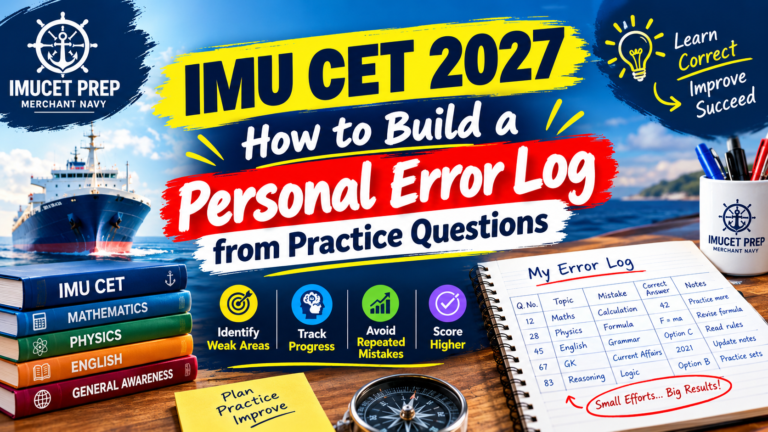
Month 2 — Practice Intensive: Move to full-length mock tests roughly every 10 days, under real exam timing. Work through previous year papers section by section, and start maintaining a written error log of recurring mistakes across all subjects.
Month 3 — Revision and Time Management: Stop introducing new topics entirely. Take a full mock test every 4–5 days, and use each result to fine-tune how much time you allocate per section on exam day — this is often the single biggest score improvement available in the final stretch. For a week-by-week structure to follow through these three months, see our complete IMU CET 2027 preparation timeline. For the official exam calendar and eligibility notification, always cross-check details on the Indian Maritime University’s official website.
Conclusion
IMU CET 2027 preparation with school isn’t about finding extra hours that don’t exist — it’s about using the hours you already have more intelligently. When you let school do the heavy lifting for Physics, Chemistry, and Maths, and layer focused daily practice on top for English and General Aptitude, the two tracks stop competing and start reinforcing each other. Add a realistic weekly routine, regular mock tests, and a genuine revision buffer in the final three months, and IMU CET 2027 becomes a natural extension of your Class 11–12 journey rather than a second, exhausting exam to prepare for from scratch.
Ready to Start Your IMU CET 2027 Preparation?
You don’t have to figure out the schedule, mock tests, and subject strategy on your own. At IMUCETprep, we help school students build a personalised IMU CET 2027 study plan that fits around their board exams — not against them.
👉 Explore our IMU CET 2027 course and study plans to get a structured, week-by-week roadmap.
👉 Take a free IMU CET 2027 mock test to see exactly where you stand today.
👉 Have questions about balancing school and IMU CET? Talk to our counsellors for a free 1-on-1 preparation plan.
The earlier you start, the lighter each day feels — begin your IMU CET 2027 preparation with school today, and walk into exam day prepared instead of panicked.
Frequently Asked Questions (FAQs)
Q1. Is it realistic to prepare for IMU CET 2027 starting from Class 11?
Yes, and it’s often the least stressful route. Starting early spreads Physics, Chemistry, and Maths revision gradually while giving you extra time to build English and Aptitude skills that school doesn’t cover.
Q2. How many hours should a school student study for IMU CET daily?
Most students manage well with 2–3 focused hours on weekdays and 5–6 hours on weekends, increasing only in the final 3 months before the exam.
Q3. Does the IMU CET syllabus match the Class 12 board syllabus exactly?
Physics, Chemistry, and Mathematics follow the standard Class 12 syllabus. English and General Aptitude are additional sections that require separate preparation outside school.
Q4. Should IMU CET preparation stop completely during school exams?
No — reduce it to light, low-effort revision instead of stopping altogether, then return to full intensity within a few days of finishing your school papers.
Q5. When is the right time to start taking mock tests?
Begin topic-wise tests as soon as you complete a chapter for the first time, then shift to full-length, timed mock tests in the final three months before IMU CET 2027.
Q6. Can school toppers automatically expect to do well in IMU CET?
Not necessarily. School exams reward depth in a fixed syllabus, while IMU CET also tests speed, aptitude, and English — areas that need dedicated practice regardless of how well a student performs in board exams.