How to Become a Deck Officer in Merchant Navy After 12th: Complete Step-by-Step Guide
Introduction
Goal: Become a Deck Officer in Merchant Navy after 12th .
Eligibility: 10+2 with PCM (Minimum 60%), Age 17-25 years.
Medical: 6/6 vision, no color blindness, physically fit.
Exams: Clear IMU CET and secure company sponsorship.
Training: Enroll in a Diploma in Nautical Science (DNS) or B.Sc Nautical Science. Sea Time: Complete 18 months of mandatory onboard training.
Certification: Pass MMD competency exams to earn your Certificate of Competency (CoC).
Starting Salary: ₹2,000,000 – ₹5,000,000+ per year (tax-free in most cases).
A young 18-year-old cadet steps onto the massive steel deck of a commercial vessel for the very first time. Fast forward just five years, and that same cadet is standing confidently on the bridge, navigating a multimillion-dollar cargo ship across the Pacific Ocean as a respected captain. This isn’t a movie plot; it is the real-life trajectory for those who choose to become a Deck Officer in Merchant Navy.
According to data from the International Maritime Organization (IMO), over 1.5 million seafarers work globally in 2026, keeping the arteries of international trade flowing. If you have ever looked at the vast ocean and wondered how to turn that horizon into your workplace, you are in the right place.
Transitioning from a high school student to a merchant navy deck officer requires dedication, the right guidance, and a clear roadmap. This comprehensive guide will show you exactly how to become a Deck Officer in Merchant Navy right after your 12th-grade board exams. From cracking the entrance tests to surviving your first storm at sea, we will cover the entire journey. Before we dive into the deep end, let’s quickly look at the foundational eligibility you need to even step foot on the gangway.
1: Check Eligibility and Prep Basics
Before you start dreaming of your deck officer jobs merchant navy career, you must meet strict international standards. The sea is unforgiving, and the regulations ensure that only the most capable candidates take on deck officer positions at sea.
Meet Age, Education, and Health Rules
To begin your deck cadet merchant navy journey, your academic and physical foundations must be rock solid.
- Academics: You must have completed your 12th standard (10+2) with Physics, Chemistry, and Mathematics (PCM). A minimum of 60% aggregate marks in PCM is mandatory, along with at least 50% marks in English in either your 10th or 12th boards.
- Merchant Navy age limit: Candidates must be between 17 and 25 years of age at the time of commencement of the course.
- Medical Fitness: The Directorate General of Shipping (DG Shipping) norms are incredibly strict regarding medical fitness. You need perfect 6/6 eyesight in at least one eye (6/9 allowed in the other, but correctable to 6/6), and absolutely no color blindness.
Actionable Advice: Do not wait until the last minute. Book an eye test with a DG Shipping-approved doctor early in your 12th grade to ensure you meet the visual standards for a Deck Officer in Merchant Navy after 12th.
Is the Merchant Navy Govt or Private?
A common question students ask is whether a Merchant Navy officer is govt or private. The Merchant Navy is a purely commercial, private sector industry. Unlike the Indian Navy, which is a defense force, the Merchant Navy deals with the commercial transportation of cargo and passengers. However, your training, licensing, and certifications are heavily regulated by government bodies like the Directorate General of Shipping.
Build Key Skills Before Applying
Academic brilliance is just one part of the equation. To thrive in a deck officer role on navy ships, you need practical skills.
- Physical Conditioning: Learn to swim at least 50 meters. While you will have life-saving appliances on board, swimming is a fundamental survival skill.
- Nautical Basics: Start learning basic knots and introductory navigation concepts.
- Discipline: Join the National Cadet Corps (NCC) if your school offers it. It provides a massive edge in discipline and leadership.
2: Crack Entrance Exams and Interviews
Once you have your eligibility sorted, the next hurdle is securing your seat. Getting into a top-tier maritime institute is competitive, but with the right preparation, you can secure your path to becoming a Deck Officer in Merchant Navy after 12th.
Top Exams to Target
The most critical exam you will face is the Indian Maritime University Common Entrance Test (IMU CET). As of recent 2025 data, there are over 10,000+ seats available yearly across various maritime colleges, and the IMU CET is your primary gateway. Some premium private institutes also accept JEE scores, but the IMU CET remains the gold standard.
Prep Plan: Dedicate at least 6 months to focused preparation. Your core focus should be on Mathematics, Physics, and General Aptitude, with a strong emphasis on English comprehension. For top-tier study materials, mock tests, and expert guidance, leveraging resources from specialized platforms like IMU CET Prep can significantly boost your rank.
Sponsor Hunt and Company Tests
Passing the exam is only half the battle. To secure dg shipping deck cadet admission for a Diploma in Nautical Science (DNS), you must secure sponsorship from a shipping company. Giant shipping firms like Maersk, Anglo-Eastern, and Synergy conduct their own rigorous aptitude, psychometric, and interview tests to sponsor top scorers.
As Capt. Singh, a veteran interviewer, puts it: “Sponsors cover the fees and guarantee you a ship, but they don’t just pick students; they pick future leaders.”
3: Enroll in IMU-Approved Courses
Once you clear the exams and secure your sponsorship, it is time to start your formal education. To become a Deck Officer in Merchant Navy, you generally have two main educational routes.
Choose DNS or B.Sc Nautical Science
| Feature | Diploma in Nautical Science (DNS) | B.Sc in Nautical Science |
| Duration | 1 Year (Pre-sea) + 18 Months (Sea-time) | 3 Years (Pre-sea) + 12 Months (Sea-time) |
| Sponsorship | Mandatory before starting the course. | Not mandatory to start, but highly recommended. |
| Cost Estimate | ₹8 – ₹12 Lakhs | ₹10 – ₹18 Lakhs |
| Best For | Students wanting to start earning and going to sea quickly. | Students wanting a traditional 3-year college degree experience. |
| Pass Rate | ~85% (Due to strict sponsorship screening) | Varies by institute |
What Training Covers Daily
Your pre-sea training to become a Deck Officer in Merchant Navy is intense. You aren’t just reading books; you are preparing for survival and operational excellence.- Deck officer duties merchant navy: You will study celestial navigation, ship stability, meteorology, and maritime law.
- Daily tasks deck officer ship: Training mimics ship life. You wake up early, do physical training (PT), attend workshops, and maintain strict uniforms.
- Simulator Practice: You will spend hours in high-tech bridge simulators, practicing how to steer a ship through heavy traffic or severe weather conditions.
4: Gain Sea Time and Get Certificates
You have passed the theory; now it is time to face the ocean. This phase separates the theorists from the true sailors.
First Voyage as Trainee
To fulfill your deck officer qualifications, you must complete mandatory sea time. If you took the DNS route, this is an 18-month rigorous period. If you did B.Sc Nautical Science, it is 12 months. During this time, your core focus is mastering the daily tasks deck officer ship routines.
You must log at least 6 months of bridge watchkeeping duties under the supervision of a certified officer. Your navigation duties deck officer and cargo operations deck officer skills will be tested daily.
Real Story ; a young deck cadet, faced his first massive storm in the Bay of Biscay during his 4th month at sea. Because he had meticulously practiced his safety drills and understood his watchkeeping deck officer protocols, he assisted the Chief Officer in securing loose cargo under immense pressure, proving his worth to the captain.
Pass Exams for Officer Rank
Sea time alone doesn’t make you a Deck Officer in Merchant Navy. You must pass the ultimate test: the competency exam deck officer. These are the Directorate General of Shipping MMD (Mercantile Marine Department) tests, consisting of grueling written papers and oral examinations conducted by seasoned Master Mariners.
Additionally, you must secure your STCW certification deck officer (Standards of Training, Certification, and Watchkeeping), which proves you are qualified to handle lifeboats, advanced firefighting, and medical first aid.
Statistics show that roughly 70% of cadets clear their coc exam deck officer (Certificate of Competency) on the first try if they have engaged in disciplined self-study during their sea time. Once that piece of paper is in your hand, you are officially a licensed Deck Officer in Merchant Navy.
5: Launch Your Career and Climb Ranks
With your CoC secured, you step onto the ship not as a trainee, but as an officer. The deck officer career path is highly structured, rewarding performance, experience, and further examinations.
Entry Jobs and Pay Scale
Understanding the Merchant Navy salary and Merchant Navy Officer ranks is usually the most exciting part for aspirants.
- 3rd Officer / 2nd Officer: You begin your career here. The merchant navy deck officer pay scale at this level is incredibly lucrative. A starting deck officer salary merchant navy ranges from ₹2 lakhs to ₹5 lakhs per month, depending on the type of ship (oil tankers and gas carriers pay more than bulk carriers) and the company.
- Chief Officer (Chief Mate): With 3-5 years of experience and passing the next level of MMD exams, you can earn a promotion deck officer to chief mate. Here, salaries often jump to ₹6 lakhs to ₹9 lakhs per month.
- Captain (Master): The pinnacle of the deck officer career path. Earning upwards of ₹10 lakhs to ₹15 lakhs a month.
When evaluating the life of merchant navy officer salary, it is vital to remember that if you sail for more than 182 days in a financial year outside Indian territorial waters, your income becomes completely tax-free under NRI status.
What is the life style of an merchant navy officer?
While the pay is fantastic, you must understand the life as deck officer merchant navy. The Life of merchant navy officer is a unique blend of high adventure, deep responsibility, and significant isolation.
Lifestyle and Challenges:
- Work-Life Balance: Achieving a deck officer work life balance means working intensely for 4-6 months at sea, followed by 2-4 months of complete vacation at home.
- Family Life: The family life merchant navy deck officer can be tough. You will miss birthdays, anniversaries, and festivals. However, the extended vacations allow for uninterrupted quality time that shore jobs rarely offer.
- Challenges at Sea: The challenges deck officer sea include navigating varying time zones, sleep deprivation during port stays, and harsh weather.
To overcome homesickness, build a strict daily routine. A veteran Fleet Manager advises: “Fitness keeps you sharp at sea. A strong body handles the mental fatigue of isolation much better.” Health tips deck officers:
- Utilize the ship’s gym daily.
- Monitor your diet, as ship food can be calorie-dense.
- Keep your mind active through distance learning or reading.
Pro Tip: Save 50% of your massive salary from day one. Financial freedom is the ultimate perk of this career. Network with port agents and company superintendents to secure placements in the best companies deck officers want to work for.
Final Thoughts
Becoming a Deck Officer in Merchant Navy is a journey of transformation. It requires academic rigor, physical endurance, and mental toughness. Let’s recap the blueprint:
- Check Eligibility: Ensure your PCM marks and medical fitness (especially eyesight) are up to the mark.
- Crack the Exams: Prepare aggressively for the IMU CET and secure a company sponsorship.
- Complete the Course: Excel in your DNS or B.Sc Nautical Science program.
- Conquer the Sea: Finish your 18 months of sea time and pass the MMD CoC exams.
- Climb the Ranks: Step aboard as a 3rd Officer, enjoy the tax-free salary, and aim for the Captain’s chair.
The sea is waiting, but it only favors the prepared. If you are currently in your 11th or 12th grade, your timeline starts now. Urge yourself into action: start your preparation and aim to apply for the IMU CET by June 2026.
For More Information
Contact us at – Imucet.prep
Frequently Asked Questions
1. Is the Merchant Navy a government or private job?
The Merchant Navy officer is govt or private query is common among beginners. Essentially, the Merchant Navy is a private commercial sector. You work for private shipping companies (like Maersk or MSC). However, the industry is strictly regulated by the Directorate General of Shipping (DGS), a government body under the Ministry of Ports, Shipping, and Waterways.
2. What is the Merchant Navy age limit for Deck Officers?
For most entry-level courses like DNS or B.Sc Nautical Science, the Merchant Navy age limit is generally 17 to 25 years at the time of course commencement. Candidates from reserved categories (SC/ST) may receive a 5-year relaxation as per government norms.
3. Can I join as a Deck Officer if I have spectacles?
While the rules for engineering roles are more relaxed, the requirements for a Deck Officer in Merchant Navy are very strict. You must have 6/6 vision in your better eye. Some companies allow corrected vision (glasses) as long as it is 6/6, but color blindness is a total disqualifier for the deck department.
4. What is the lifestyle of a merchant navy officer really like?
What is the lifestyle of a merchant navy officer? It is a unique mix of high-pressure work and world-class luxury. You live in a floating city with modern amenities, but the life of a merchant navy officer also involves staying away from home for months. The trade-off is a 4-on/2-off or 6-on/2-off month contract system, giving you long, paid vacations.
5. How does the Merchant Navy salary compare across ranks?
The Merchant Navy salary is one of the highest in the professional world. Here is a quick look at the Merchant Navy Officer ranks and their monthly pay:
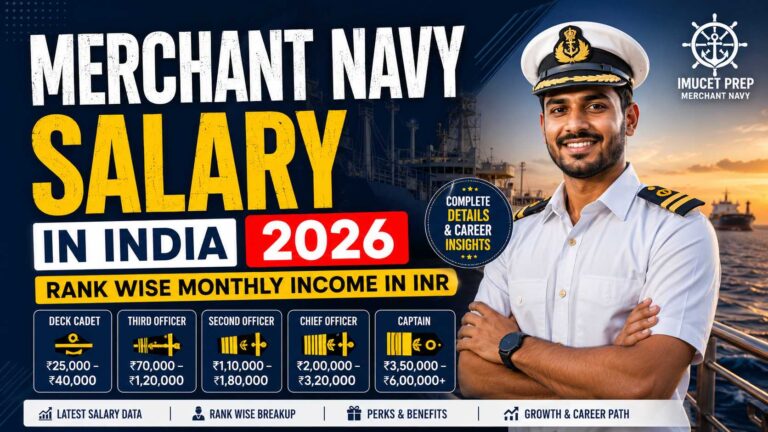
| Rank | Average Monthly Salary (INR) | Key Responsibilities |
| Deck Cadet | ₹25,000 – ₹85,000 | Training, maintenance, and learning. |
| 3rd/2nd Officer | ₹2,00,000 – ₹4,00,000 | Navigation, safety, and communications. |
| Chief Officer | ₹5,00,000 – ₹8,00,000 | Cargo operations and crew management. |
| Captain (Master) | ₹8,00,000 – ₹15,00,000+ | Overall command and vessel safety. |
6. Is the salary tax-free in India?
Yes, the Life of merchant navy officer salary is typically tax-free in India, provided you maintain Non-Resident Indian (NRI) status by spending more than 182 days outside the country in a financial year.
7. Do I need to know how to swim to join?
While you don’t need to be an Olympic swimmer, knowing how to swim is a mandatory part of your STCW certification deck officer training. Most institutes will teach you basic survival swimming during your pre-sea course.