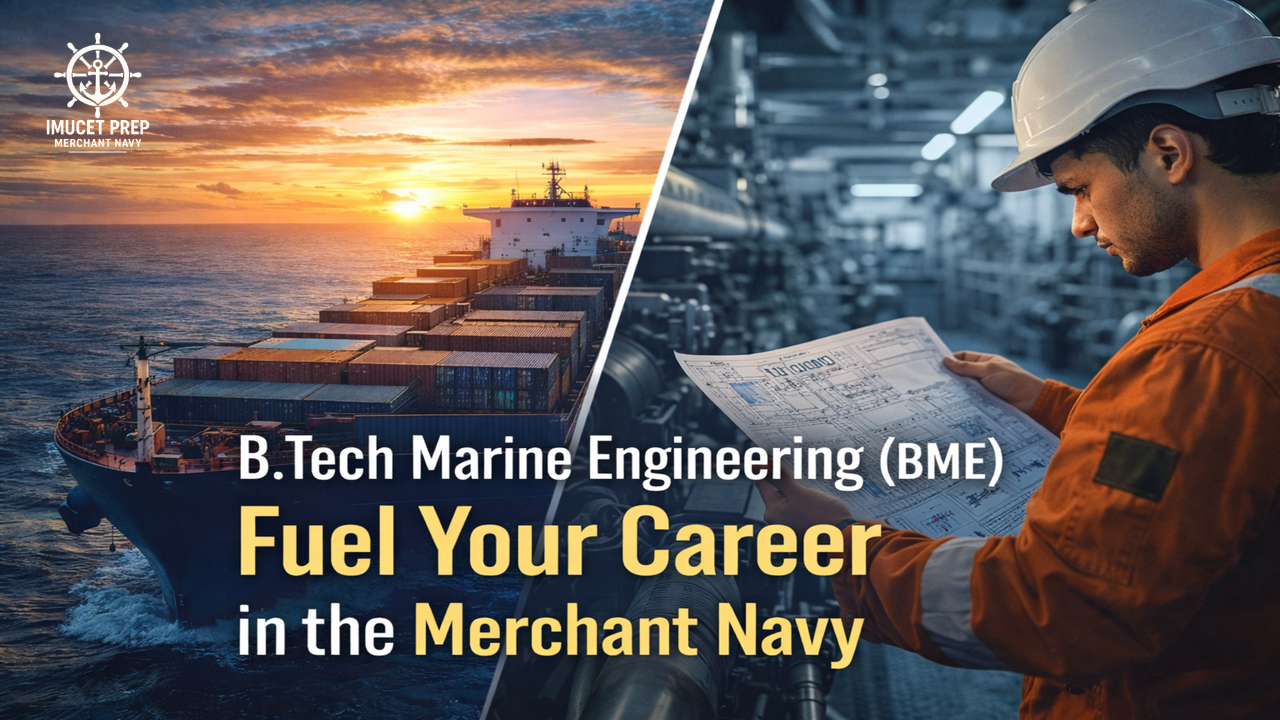
B.Tech Marine Engineering (BME): Fuel Your Career in the Merchant Navy
Imagine waking up to an endless ocean view, the hum of a massive 100,000-horsepower engine beneath your feet, and the knowledge that your work is powering global trade. Are you ready for an adventurous life and high-paying jobs on massive cargo ships?
If the idea of a standard 9-to-5 desk job leaves you uninspired, B.Tech Marine Engineering (BME) is your gateway to a thrilling, lucrative career in the Merchant Navy. Here at imucet prep, the leading Merchant Navy coaching in Hisar, we help driven students turn this dream into reality. We guide you through the entrance exams, medical tests, and counseling processes required to secure a seat in top maritime institutes.
B.Tech Marine Engineering (BME) offers unparalleled benefits, including global travel to exotic ports and tax-free, fat paychecks right from the start of your career. To put the scale of this industry into perspective, the Merchant Navy currently employs over 1.8 million seafarers worldwide (according to IMO 2025 data). Let’s dive deep into how this degree can fuel your future.
What Is B.Tech Marine Engineering (BME)?
The BME full form stands for Bachelor of Technology in Marine Engineering. It is a specialized undergraduate program that teaches students how to design, build, operate, and maintain the complex machinery of ships.
Core Focus and Skills Gained in the Course
The curriculum heavily focuses on ship engines, maritime navigation, and advanced safety protocols. As a student, you don’t just sit in a classroom; you build hands-on, practical skills in heavy machinery workshops and high-tech ship simulators.
Why is this skill set so crucial? A staggering 90% of world trade moves by sea. The global economy relies on ships, and those ships rely entirely on marine engineers to keep their propellers turning.
B.Tech Marine Engineering vs. Other Engineering Degrees
If you compare it to a traditional mechanical or computer science degree, the differences are stark:
- More adventure than desk jobs: Instead of a cubicle, your office is a multi-million-dollar floating vessel traveling the globe.
- Real-world tech operations: You are directly responsible for operating massive propulsion plants, power generators, and HVAC systems in real-time.
“BME grads run the engines that power global trade. It’s an engineering challenge unlike any other, requiring quick thinking and immense technical capability.” – Capt. Raj Singh, 20-year Merchant Navy veteran.
Why Pursue This Path for the Merchant Navy?
Choosing the right undergraduate program is a major life decision. Here is why this specific route is highly rewarding:
High Demand and Job Security
The maritime industry is currently facing a massive talent gap. According to recent maritime reports, there will be a significant shortage of maritime officers over the next few years. This means jobs after graduation are abundant. Even during tough global economic conditions, ships must continue sailing to transport food, fuel, and goods, offering you incredibly steady gigs.
Lifestyle and Perks of Graduates
The lifestyle of a seafarer is unique and highly rewarding:
- Global Travel: You can expect to travel to numerous ports yearly, seeing the world while getting paid.
- Incredible Financial Growth: The fresher salary can be highly competitive, with tax-free salaries reaching up to ₹15 lakh in the very first year (depending on the shipping company and your NRI status).
Actionable takeaway: Because your food, accommodation, and travel are covered while offshore, a smart engineer can easily save up to 70% of their offshore income.
B.Tech Marine Engineering Course Details and Syllabus
To succeed, you need to understand the admission process, eligibility, and what you will study over the next four years.
Duration, Eligibility, and Admission Process
The program is a 4-year, 8-semester degree pursued after completing Class 12.
The syllabus is rigorously designed to meet international maritime standards. The 1st-year subjects usually cover advanced engineering physics, mathematics, and basic workshop technology. As you progress, the subjects become highly specialized.
Key modules include:
| Requirement | Details |
| Academic | 10+2 with Physics, Chemistry, and Mathematics (PCM). Must have a minimum of 60% aggregate in PCM, and at least 50% in English (in 10th or 12th). |
| Entrance Exam | Must qualify the mandatory all-India IMU CET. |
| Age Limit | Maximum 25 years for General candidates (relaxed to 30 years for SC/ST). |
| Medical Standards | Must be physically fit. Eyesight should be 6/6 or 6/12 in each eye, with absolutely no color blindness. |
- Thermodynamics & Propulsion: Understanding diesel engines, steam turbines, and gas turbines.
- Engine Room Operations: Managing auxiliary machinery, pumps, and piping systems.
- Electrical Systems: High-voltage systems and shipboard electrical automation.
- Environmental Laws: MARPOL regulations and marine pollution prevention.
Top B.Tech Marine Engineering Colleges and How to Get In
As the top choice for Merchant Navy coaching in Hisar, Imucet Prep often advises students on college selection. While there are no prominent maritime colleges directly in Hisar, students from our region have excellent options in nearby Haryana, North India, and premier institutes across the country.
Fees Structure & Scholarships
Course fees typically range from ₹8 lakh to ₹12 lakh in total for the four-year program. While this might seem like a heavy investment, the rapid ROI (Return on Investment) makes it worthwhile. Furthermore, scholarships are widely available based on merit and IMU CET ranks, sometimes covering up to 50% of tuition for exceptional students.
Tips to Crack the Entrance Exams for B.Tech Marine Engineering
To secure a seat in these top institutions, you must master the admission funnel:
- Prep for IMU CET: Join a specialized coaching program like Imucet Prep to take regular mock tests.
- Action Steps: Aim to score 150+ in your entrance exam to comfortably clear the cutoff ranks.
- Medical Fitness: Pass the rigorous DG Shipping-approved medical fitness test well in advance.
Career Paths, Jobs After B.Tech Marine Engineering, and Placements
The career scope is massive, offering a structured and highly rewarding promotion ladder.
Salary in India and Offshore Jobs
Once you complete your degree and initial sea time, you enter the professional ranks:
- Start as a Junior / 4th Engineer: Earning approximately ₹10-12 lakh per year.
- Rise through the Ranks: Moving from 3rd Engineer to 2nd Engineer.
- Peak Career (Chief Engineer / Captain): With around 10 years of experience, a Chief Engineer oversees the entire mechanical operation of the ship, earning ₹50 lakh+ annually.
You also have access to offshore jobs on oil rigs, drill ships, and in the logistics sector.
Actionable Advice for Students
To maximize your placements, follow these pro tips:
- Network on LinkedIn: Connect with alumni and shipping company HRs early on.
- Log 12 Months Sea Time Fast: Do not delay your mandatory onboard training.
- Learn Automation Trends: The future of shipping is automated and green (LNG, hydrogen fuels). Stay ahead of the curve.
- Maintain Compliance: Always renew your STCW and medical certificates every 5 years.
Conclusion
A B.Tech Marine Engineering (BME) degree is more than just an academic qualification; it is your ultimate ticket to sea success, adventure, and financial independence. With lifetime earnings potentially crossing the ₹1.5 crore mark within your first decade at sea, the intense training and discipline required are well worth the effort.
If you are a student in or around Haryana dreaming of the merchant navy, you don’t have to navigate this journey alone. Imucet Prep in Hisar is dedicated to turning local students into global mariners.
FAQs
- Which college is best for B.Tech in Marine Engineering?
The top choices are the Indian Maritime University (IMU) campuses and premier DG Shipping-approved institutes, which require a high entrance exam rank. Imucet Prep provides the exact study materials, mock tests, and expert guidance you need to secure that top rank and get into your dream college.
- Is Biomedical Engineering a B.Tech degree?
Yes, it is a 4-year undergraduate degree. However, it is entirely different from a maritime engineering degree. While Biomedical focuses on healthcare and medical devices, the maritime path is dedicated to ship mechanics, engine room operations, and a career at sea.
- How to join this program?
To join, you must meet the following criteria:
- Academics: Complete your 10+2 with Physics, Chemistry, and Mathematics (PCM), scoring a minimum of 60% aggregate.
- Medical Standards: Pass strict maritime medical fitness tests (including 6/6 or 6/12 vision in both eyes and no color blindness).
- Entrance Exam: Successfully clear the IMU CET.
- What is the syllabus for IMU CET?
The IMU CET syllabus is primarily based on the 10+2 curriculum. It covers Physics, Chemistry, and Mathematics (PCM), along with English, General Aptitude, and General Knowledge. At Imucet Prep, we provide updated, chapter-wise study materials that focus specifically on the topics most likely to appear.
- Is IMU CET difficult to crack?
While highly competitive due to the limited number of seats in top DG Shipping-approved colleges, it is very manageable with the right strategy. With the structured mock tests, shortcut techniques, and expert mentoring available at Imucet Prep, candidates can significantly boost their confidence.
- What is the starting salary after graduation?
A career in the Merchant Navy is highly rewarding. Joining a ship as a Junior or Fifth Engineer typically brings starting stipends/salaries ranging from ₹50,000 to ₹80,000 per month. As you get promoted to Chief Engineer, salaries can rise to between ₹5,00,000 and ₹10,00,000 per month (often tax-free).
- Can girls apply for IMU CET and marine roles?
Absolutely! Female candidates are highly encouraged to join the Merchant Navy. In fact, DG Shipping and many maritime colleges offer fee concessions and special scholarships to promote women in seafaring roles. Imucet Prep provides comprehensive guidance to help all aspirants secure their dream maritime career.
- What is the age limit for IMU CET and B.Tech Marine Engineering?
Generally, candidates must be between 17 and 25 years of age on the date the academic session commences. There is usually an age relaxation of up to 5 years for SC/ST candidates. It is important to verify your eligibility and start preparing early.