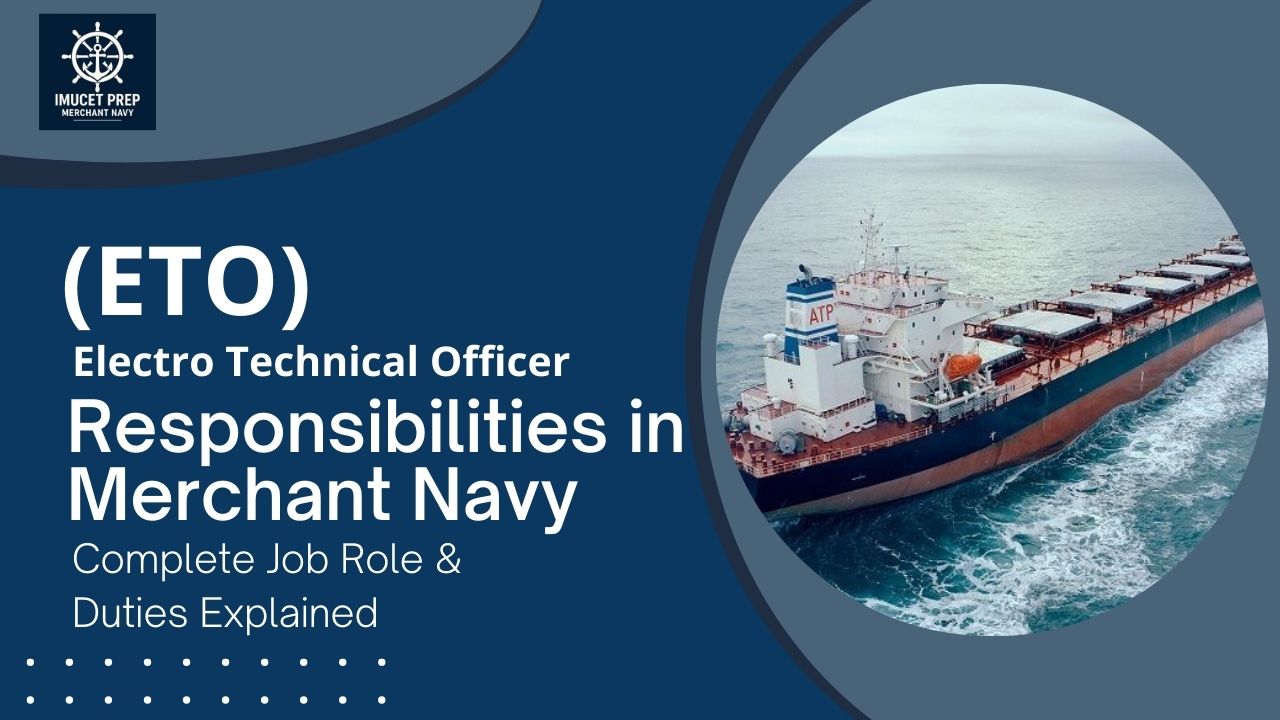
Electro Technical Officer (ETO) Responsibilities in Merchant Navy: Complete Job Role & Duties Explained
A Electro Technical Officer (ETO) is the electrical backbone of a merchant ship, responsible for handling power systems, automation, navigation electronics, and emergency repairs onboard. Learn full ETO responsibilities, duties, eligibility, syllabus, salary, and career scope in this detailed guide.
Introduction
If you ever picture a giant ship battling rough seas, lights flickering due to a sudden power surge… there’s one person everyone runs to — the Electro Technical Officer (ETO). And trust me, without an Electro Technical Officer (ETO), even the most advanced ship becomes helpless.
People often think engineers only fix engines, but the truth is, ships today run on electronics, automation, high-tech navigation systems, and control panels — and the one who handles all this is the ETO.
With over 50,000 merchant vessels worldwide and increasing digitalization, the demand for skilled Electro Technical Officers has shot up by 15% since 2020 (IMO data).
This blog will explain every part of the job — ETO duties, daily responsibilities, skills, salary, course details, eligibility, exams, challenges, and growth opportunities, all in a simple, conversational way.
Let’s begin this journey toward understanding the real life of the ETO onboard.
Who is an Electro Technical Officer (ETO)?
An Electro Technical Officer (ETO) is the electrical and electronics expert onboard a ship. Their job is to ensure everything that runs on power, chips, wires, and digital systems works smoothly 24×7.
They are basically the bridge between ship operations and electrical/electronic systems.
Ships today run on technology, and ETOs keep that technology alive.
Qualifications Needed
To work as an Electro Technical Officer in Merchant Navy, seafarers must meet these qualifications:
- STCW ETO Certification
- Diploma or Degree in Electrical, Electronics, or EEE
- Age above 21
- Basic Safety Training
- Valid Medical Fitness Certificate
- Some sea-time (varies by company)
A Marine Insight 2024 report said that 70% of new ETO hires now come with full electrical engineering degrees.
⚡ Difference Between ETO & Other Engineering Roles
Many students get confused between ETO, electricians, and marine engineers. Here’s the simplest explanation:
- Marine Engineers → Handle engines, boilers, pumps, propulsion
- Electricians → Do basic wiring and electrical repairs
- ETO → Handles automation, navigation electronics, control systems, IT systems, power distribution, radar, GPS, communication, alarms, PLC, and advanced circuitry
A real example:
If the navigation radar stops during a storm — the ETO fixes it.
If the main engine overheats — the marine engineer handles it.
As Capt. Rajesh Sharma says:
“ETOs keep the ship’s brain alive.”
⚙️ Core Daily Responsibilities of an Electro Technical Officer (ETO)
Now let’s break down real onboard responsibilities.
- Electrical System Maintenance
Every morning, the ETO does routine rounds to ensure everything is running perfectly.
Daily Tasks Include:
- Checking generators & emergency generator
- Inspecting main switchboard
- Testing batteries & UPS
- Monitoring power load
- Checking lighting panels
- Inspecting electric cables
Takeaway:
If you follow a checklist properly, 90% failures can be avoided.
2. Troubleshooting & Repairs
This is where the real pressure lies. When something breaks onboard, everyone waits for the ETO to fix it — fast.
Common Emergencies ETO Handles:
- Power blackouts
- Navigation failure
- Communication breakdown
- Engine automation failure
- Switchboard trips
- Alarm system malfunction
Example:
In a 2023 Maersk vessel blackout, ETOs restored full power in 2 hours, preventing a potential collision.
ETOs must master:
- Multimeter
- PLC Programming
- Fault-finding techniques
- Circuit reading
🔧 Technical Duties & Expertise
Ships today are fully automated. ETOs handle systems that even mechanical engineers don’t touch.
Navigation & Communication Systems
ETOs are responsible for:
90% of major incidents happen due to electronic failures (Allianz Safety Report 2025).
Key Duties:
- Calibrating navigation systems
- Updating software
- Backing up voyage data
- Checking communication signal quality
Automation & Control Systems
Ships depend heavily on automation.
ETOs monitor:
- PLC panels
- Fire detection systems
- Engine automation
- Bilge alarms
- Ballast automation
- Cargo control systems
ETO trainer Maria Lopez says:
“Automation reduces human error by almost 40%.”
🚨 Safety Protocols & Emergency Handling
ETOs play a crucial role in ship safety drills.
Key Safety Responsibilities:
- Testing fire detectors
- Running emergency shutdown simulations
- Checking battery backup
- Managing LOTO (Lock Out Tag Out)
- Ensuring PPE compliance
Emergency Handling Example:
In a 2024 storm near the Red Sea, an ETO restored partial power by rewiring emergency circuits. That saved the vessel.
Eligibility & Requirements for Becoming an ETO
Here’s a clear table for understanding eligibility:
Eligibility Table
Category | Requirement |
Age Limit | 18–30 years (varies by company) |
Qualification | Diploma/Degree in Electrical, Electronics, EEE |
Course | DG Approved ETO Course |
Medical | Must be medically fit as per DG Shipping |
Eyesight | Good eyesight and hearing |
Fitness | No major neurological or heart conditions |
Merchant Navy ETO Syllabus (Complete & Updated)
Here’s a detailed syllabus in table format:
ETO Course Syllabus
Module | Topics Covered |
Electrical Basics | AC/DC circuits, electrical machines, power distribution |
Electronics | Sensors, diodes, transistors, digital electronics |
Automation | PLC systems, control systems, SCADA |
Navigation Electronics | Radar, GPS, ECDIS, AIS |
Communication Systems | VHF, MF/HF, GMDSS basics |
Safety Systems | Fire alarms, ESD, emergency power |
Engine Room Automation | Bilge, ballast, fuel control systems |
Workshop | Soldering, wiring, troubleshooting |
Simulator Training | Hands-on PLC & navigation equipment |
How to Apply for ETO Course (Step-by-Step Guide)
Here is the simplest guide for IMU CET aspirants:
Step 1: Check Eligibility
Make sure you fulfill:
- Electrical or Electronics background
- Age & medical qualification
Step 2: Choose a DG Approved Institute
Look for:
- Government approved
- Good placement record
- Proper labs and simulators
Step 3: Apply Online
Fill out the application form on the institute website.
Step 4: Appear for Entrance/Interview
Some institutes take:
- Oral test
- Basic technical test
- Psychometric test
Step 5: Complete Course
Course duration is usually 4–6 months.
Step 6: Appear for ETO Competency Exams
Step 7: Apply for Onboard Training
Companies start hiring:
- Junior ETO
- Trainee ETO
💰 Electro Technical Officer Salary in Merchant Navy
Salaries are one of the biggest attractions.
Salary Table (Approx.)
Rank | Monthly Salary Range |
Junior ETO | ₹40,000 – ₹80,000 |
ETO (Experienced) | ₹1.5 – ₹3.5 lakh/month |
Senior ETO | ₹4 – ₹6 lakh/month+ |
Ship type also increases the eto in ship salary:
- Tankers
- LNG vessels
- Offshore Rigs
- Container Ships
These offer higher pay.
Students search terms like electro technical officer salary, eto salary in merchant navy, and highest ETO salary because pay growth is fast.
Merchant Navy ETO Course Duration & Fees
- merchant navy eto course duration → 4 to 6 months
- merchant navy eto course fees → Affordable (varies by academy)
IMUCET Prep guides you to institutes with reasonable pricing.
Career Path of an ETO
Growth Path:
- Junior ETO
- Electro Technical Officer (ETO)
- Senior ETO
- Electrical Superintendent (Shore Job)
- Technical Superintendent
- Fleet Manager (Electrical)
Seafarers Journal 2025 noted a 25% promotion rate within 5 years.
Challenges Faced by ETOs & How to Overcome Them
- Long Contracts
Solution: Stay mentally prepared and disciplined.
- High-pressure Situations
Solution: Hands-on practice before joining ship.
- Isolation at Sea
Solution: Maintain communication with family.
- Continuous Learning
Solution: Take refresher automation courses.
IMUCET Prep is one of the leading Merchant Navy preparation platforms in India, especially known in Haryana. Students get:
- Complete guidance for admissions
- Sponsorship exam training
- Technical interview preparation
- Psychometric test coaching
- Documentation help
- Affordable fee structure
- Industry-level training
- Support until placement
Thousands of students have already used their guidance to enter top shipping companies.
Conclusion
The life of an Electro Technical Officer (ETO) is exciting, challenging, and filled with opportunities. From handling power systems to maintaining high-tech navigation electronics, ETOs ensure the ship functions smoothly and safely. The demand is rising and salaries are impressive, making this a strong and futuristic career choice.
If you’re planning to become an ETO, prepare well, get the right guidance, and stay dedicated. Platforms like IMUCET Prep are helping thousands of students choose the right institute, prepare for interviews, and start their journey toward a successful merchant navy career — all at an affordable cost.
Ready to start your Merchant Navy journey?
IMUCET Prep is here to guide you every step of the way.
FAQ
1. What does an Electro Technical Officer (ETO) do in the Merchant Navy?
An Electro Technical Officer (ETO) handles all electrical, electronic, and automation systems onboard. They maintain radar, GPS, power systems, switchboards, alarms, and communication equipment. Without an Electro Technical Officer (ETO), the ship cannot run safely or efficiently.
2. What is the eligibility for the Merchant Navy ETO course?
To join the Merchant Navy ETO course, you must have a Diploma or Degree in Electrical, Electronics, or EEE. You should also meet age criteria (18–30), have medical fitness, and complete basic STCW training. These requirements ensure you can handle the responsibilities of an Electro Technical Officer (ETO).
3. What is the Electro Technical Officer salary in Merchant Navy?
The electro technical officer salary ranges from ₹40,000 to ₹80,000 for beginners and can go up to ₹4–6 lakh monthly for experienced officers. Vessel type also affects the ETO salary in Merchant Navy, with tankers and LNG ships offering higher pay.
4. What is the Merchant Navy ETO course duration?
The merchant navy ETO course duration is usually 4–6 months, depending on the institution. During this time, students learn electrical systems, automation, PLC, navigation electronics, and safety operations. The course prepares you to take up duties as an Electro Technical Officer (ETO) onboard.
5. What is included in the Merchant Navy ETO syllabus?
The merchant navy ETO syllabus includes electrical machines, electronics, PLC, automation, radar, GPS, ECDIS, fire systems, and engine room automation. This syllabus helps future Electro Technical Officers (ETO) handle modern ship technology confidently and professionally.
6. How to become an Electro Technical Officer (ETO) in Merchant Navy?
To become an Electro Technical Officer (ETO), you must complete a DG-approved ETO course, clear STCW training, and qualify for medical fitness. After completing the course, apply for onboard training as Junior ETO and gain sea experience to grow in rank.
7. Is ETO a good career in Merchant Navy?
Yes, becoming an Electro Technical Officer (ETO) is a great career choice due to high salary, modern work environment, and quick promotions. With increasing ship automation, ETO demand is rising every year, making it a secure and future-proof job.