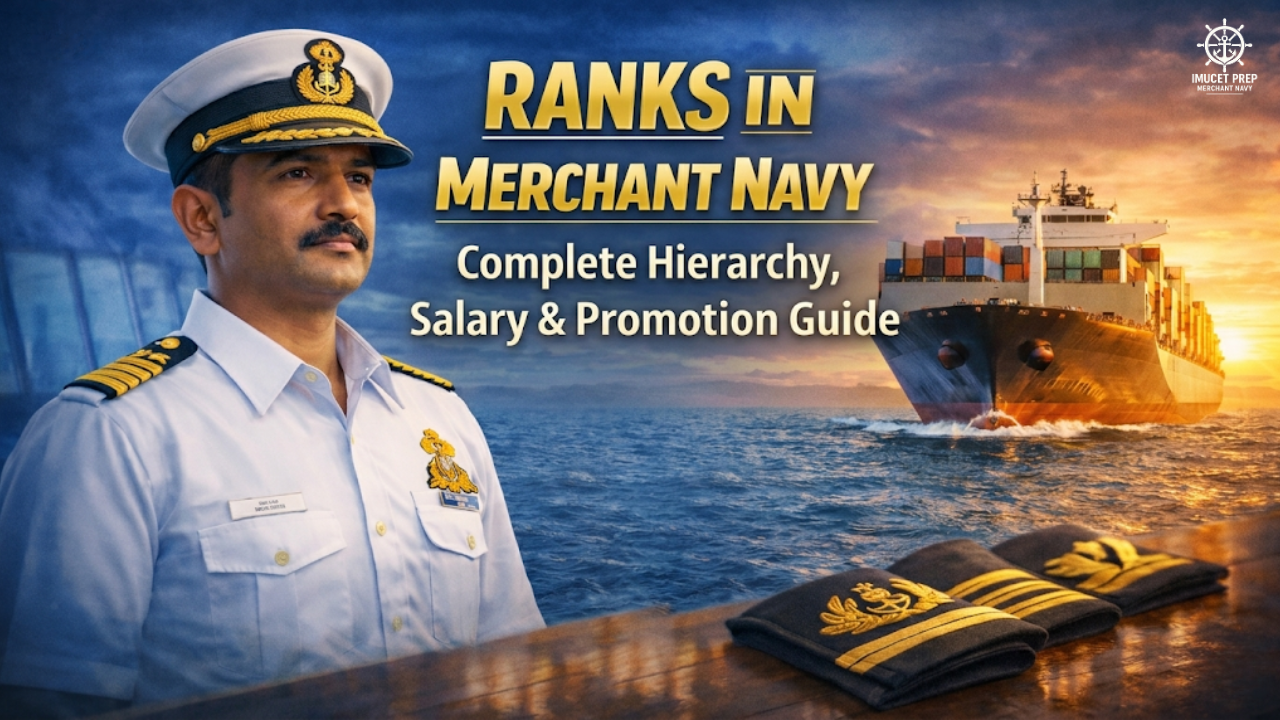
Ranks in Merchant Navy: Complete Hierarchy, Salary & Promotion Guide
Working at sea is a career that demands an immense level of professionalism. When you are navigating through unpredictable oceans, any mishap can have severe consequences. This is exactly why a strict, well-defined hierarchy is essential. The Ranks in Merchant Navy system establishes decorum, a healthy working framework, clear learning paths for junior crew members, and seamless communication between different shipboard departments.
Because mariners come from all corners of the globe and sail across international waters, it is absolutely vital that the Ranks in Merchant Navy are universally accepted and understood. This global standardization ensures that a diverse crew can coordinate perfectly, giving and following commands without confusion. The pride, heavy responsibility, and the crisp uniform associated with these ranks remain the primary reasons why thousands of passionate seafarers choose this as their ultimate career path.
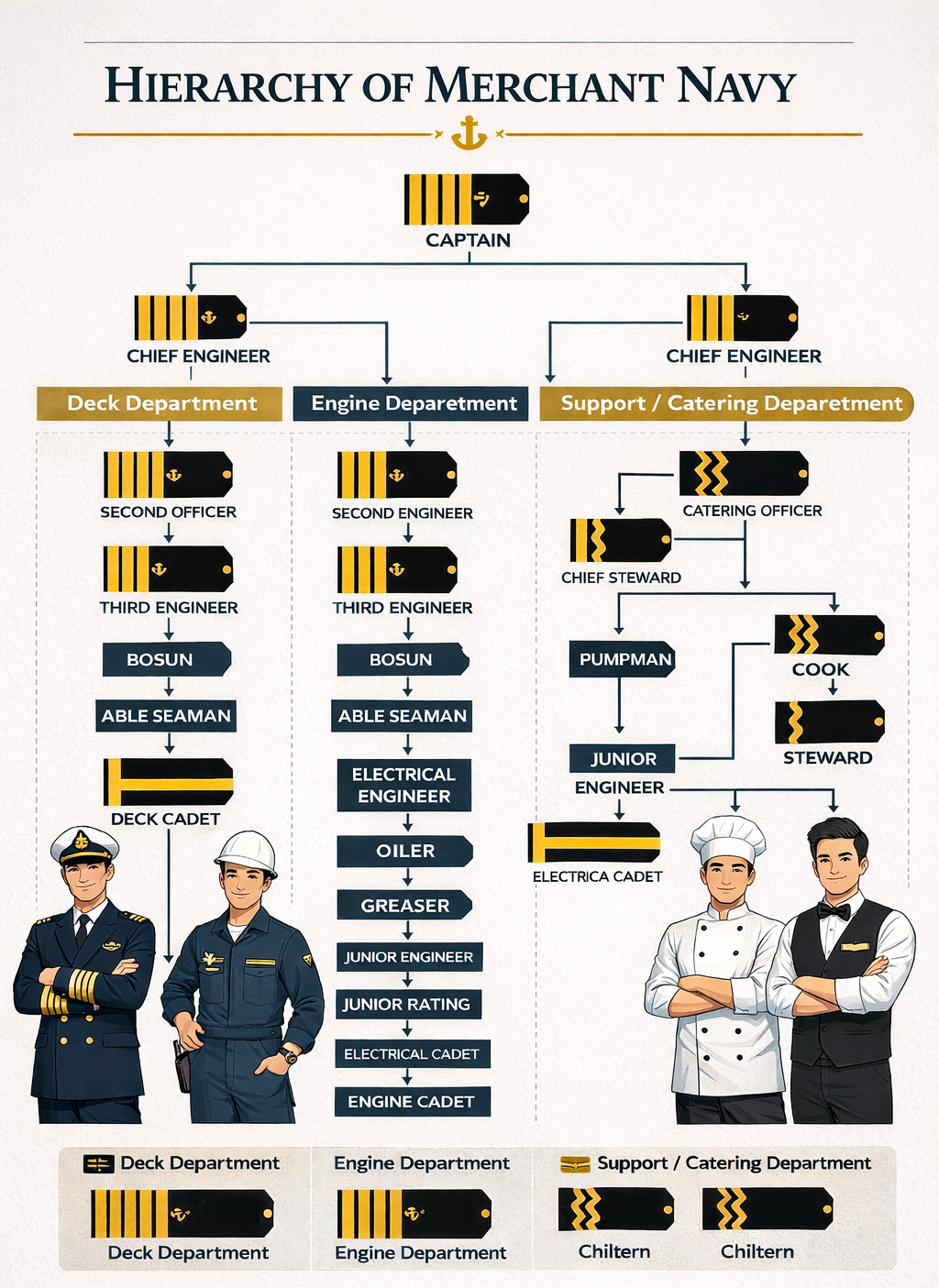
While there might be slight variations in nomenclature depending on the shipping company or the vessel’s flagship, a ship’s workforce is universally divided into three main subdivisions:
- Deck Department
- Engine Department
- Catering Department
Furthermore, within the technical and navigational departments, the crew is split into two distinct categories to accomplish tasks efficiently: Officers and Ratings.
Your Path to the Top: IMUCET Preparation
You might already be fascinated by the ships and the hierarchy, but do you know how to actually secure these prestigious ranks? What courses should you pursue, which maritime colleges should you target, and how do you clear the entrance exams to sail as an officer?
As the leading best merchant navy coaching in Haryana, our IMUCET Prep programs provide clear answers and a guaranteed pathway to your dream career. Navigating the admission process can be as complex as navigating a ship. Many talented students miss out on crucial application deadlines or choose the wrong sponsorship programs. By joining our dedicated coaching institute in Haryana, you receive expert guidance, timely updates on major forms, medical requirement checks, and top-tier academic preparation to ensure you secure top Ranks in Merchant Navy entrance exams.
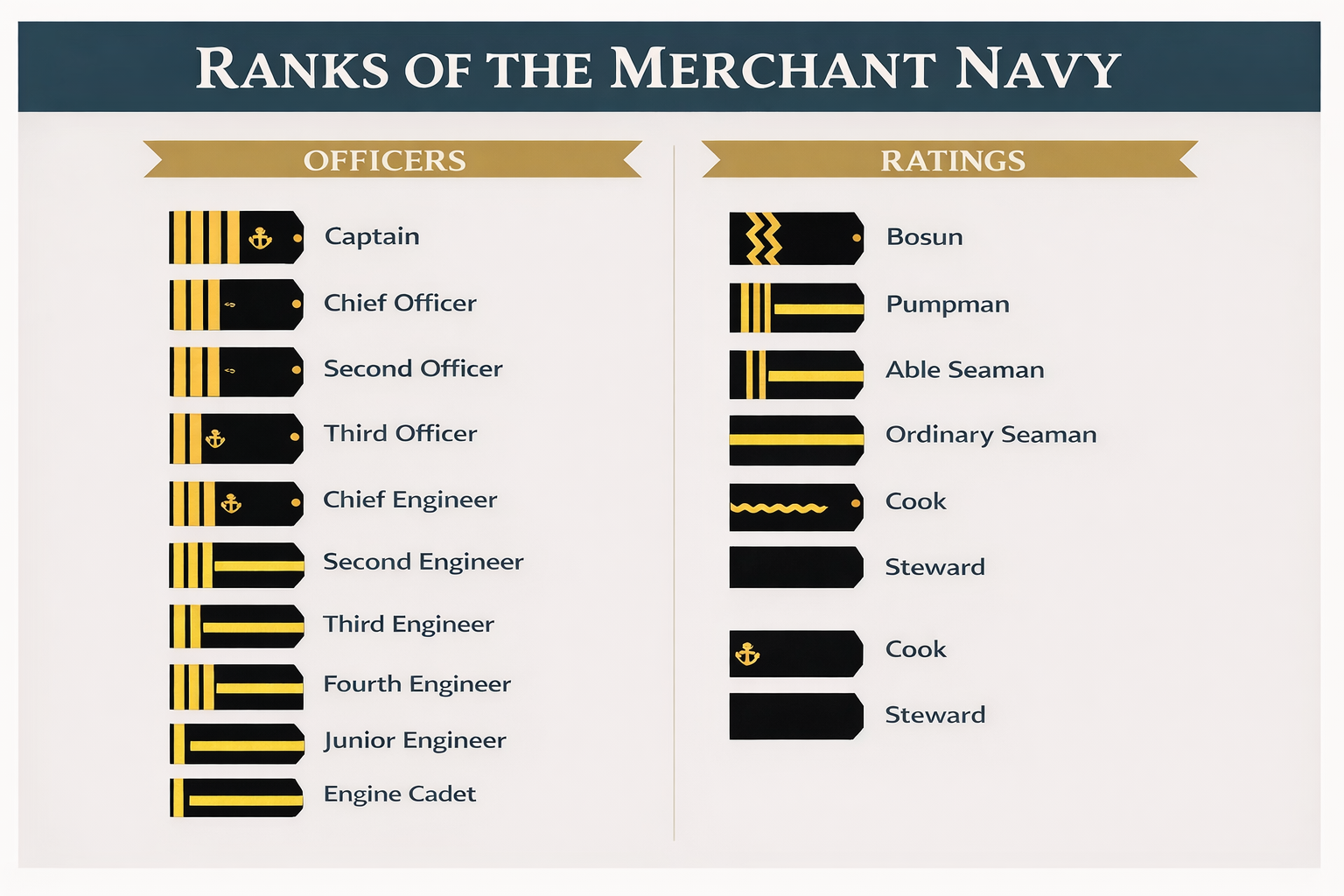
Understanding the Deck Department Ranks in Merchant Navy
The Merchant Navy isn’t part of the military, despite the “Navy” in its name. It’s all about commercial shipping. Merchant Navy professionals are responsible for transporting goods and people across the world via sea routes.
Here’s what they typically handle:
- Transporting essential commodities like oil, gas, food, and raw materials
- Managing the operations of cargo ships, tankers, container ships, cruise liners, etc.
- Navigating international waters and maintaining shipping routes
- Ensuring ship machinery and systems run smoothly
Roles in the Merchant Navy range from deck officers and marine engineers to radio officers and cadets. It’s a massive industry that supports global trade and commerce. Without it, international business would literally sink.
1. The Captain (Master)
The Captain, or Master, is the absolute supreme authority on the vessel. He is not just an officer; he is the company’s direct representative at sea. The Captain holds ultimate accountability for every job, operation, and individual on board. He ensures the ship runs smoothly under international maritime rules while optimizing functionality and minimizing operational expenses. If any mishap occurs, the Captain bears the final responsibility.
2. The Chief Officer (First Mate)
Standing right below the Master is the Chief Officer. In the absence of the Captain, the Chief Mate takes command. He is the executive head of the deck department and the supreme cargo expert on board.
The Chief Officer looks after the welfare and discipline of the vessel’s crew and takes charge of training the deck cadets. His schedule is incredibly hectic, especially when the ship is at port, as he oversees complex onshore operations like cargo gearing and berthing. Under his surveillance, critical ship security and fire prevention systems are maintained. When sailing, he typically holds the safe navigational watches between 0400 to 0800 hours and 1600 to 2000 hours.
3. Second Officer (Second Mate)
The Second Mate is the ship’s dedicated navigator. He looks after all the navigational charts, voyage planning, and ensures that all maritime publications onboard are strictly up to date. Furthermore, the Second Officer plays the crucial role of the ship’s medical officer, keeping the hospital stocked and providing medical services to the crew.
Every deck officer has specific watchkeeping hours. The Second Officer keeps the navigational watch from 1200 to 1600 hours and from 0000 to 0400 hours. At port, his duty shifts usually run from 1200 to 1800 hours and 0000 to 1200 hours.
4. Third Officer (Third Mate)
The Third Officer is primarily in charge of the ship’s safety equipment. This includes maintaining all Life Saving Appliances (LSA) and Fire Fighting Appliances (FFA), such as lifeboats, portable foam applicators, fire extinguishers, and fireman suits. He also regulates the bond store and manages essential port documents required by the Master. As an Officer on Watch (OOW), his navigational watch timings are from 0800 to 1200 hours and 2000 to 0000 hours.
5. Deck Cadet
A deck cadet is a fresh, enthusiastic trainee stepping onto a ship to learn the trade. As a cadet, your job is to absorb every bit of knowledge possible. You assist the OOW, learn how to operate critical bridge equipment, and gather the practical sea time required to appear for your competency examinations. The cadetship is the foundation of the merchant navy hierarchy.
Deck Crew (Ratings)
- Bosun: The senior-most rating and chief of the deck crew. The Bosun executes the daily deck maintenance jobs assigned by the Chief Mate.
- Able Seaman (AB): A skilled rating holding a merchant mariner’s document, certified to perform advanced deck duties and assist in watchkeeping.
- Ordinary Seaman (OS): Assigned to multiple physical tasks such as chipping, painting the superstructure, cleaning the deck, splicing wires, and overhauling gear. They also assist in cargo operations.
- Trainee OS: The rating equivalent of a cadet, onboard to learn the fundamental physical duties of a seaman.
Understanding the Engine Department Ranks in Merchant Navy
A ship cannot move without its mechanical heart. Mariners engrossed in the maintenance of the main engine, generators, and auxiliary machinery make up the engine department. Marine engineers manage the fuel, oversee power generation, and ensure the massive propulsion systems work efficiently.
1. The Chief Engineer
Parallel in rank to the Captain, the Chief Engineer is the absolute head of the technical department. He sets strict instructions for engine room operations and pollution management. The Chief Engineer monitors the performance of the main propulsion system, transfers regular fuel and lubricating oil bunker reports to the company’s headquarters, and is responsible for reporting and rectifying any severe machinery damages.
2. The Second Engineer
The Second Engineer is the operational manager of the engine room. Assisted by junior engineers, he delegates day-to-day maintenance work and trains the engine cadets. He ensures the engine room runs flawlessly and frequently keeps daytime watches. A highly skilled Second Engineer with strong troubleshooting and leadership qualities is the backbone of a happy, efficient engine room.
3. Third Engineer
The Third Engineer typically takes charge of the boiler, auxiliary engines (generators), and emergency pump lines. He ensures the ship has constant electrical power and steam. He also manages the provision reefer (refrigeration) systems, ensuring the crew’s food stays fresh. He conducts daily engine rounds under the guidance of the Chief Engineer.
4. Fourth Engineer
The Fourth Engineer usually looks after the ship’s purifiers, air compressors, and sewage treatment plants. He reports directly to the Second Engineer and manages his assigned machinery while following a strict engine round schedule. He is also often tasked with operating diesel-driven plants and the ship’s HVAC (heating, ventilation, and air conditioning) systems.
5. Engine Cadet (Fifth Engineer)
The engine cadet is onboard purely to learn. Under the strict surveillance of senior engineers, a cadet takes soundings of tanks, completes daily engine rounds, manages workshop tools, and learns to clean and dismantle critical machinery like air purifiers and compressors.
6. Electro-Technical Officer (ETO)
With modern ships becoming heavily automated and utilizing unmanned machinery spaces (UMS), the ETO is one of the most critical Ranks in Merchant Navy today. The ETO looks after all advanced electrical systems, computer-controlled machinery, and high-voltage panels. As automation becomes the industry standard, the demand for skilled ETOs is skyrocketing.
7.Engine Crew (Ratings)
- Fitter: A highly skilled craftsman specializing in welding, lathe machine operation, and pipe fitting. A good fitter makes the engineers’ lives significantly easier by constructing and assembling complex machine parts perfectly.
- Motorman / Oiler: Responsible for the smooth operation of machines by providing timely lubrication. The oiler assists the duty engineer during rounds and keeps the engine room spotless.
- Wiper: The entry-level engine rating responsible for cleaning machinery spaces and assisting senior engine crew members as commanded.
Understanding the Catering Department Ranks in Merchant Navy
Wherever there are hard-working people, nutritious meals are a strict necessity for survival and morale. The catering department handles cooking, provisions, and housekeeping.
1. The Chief Cook
The Chief Cook is the heart of the ship’s morale. He is in charge of preparing timely, nutritious, and delicious meals for the entire crew. He manages the food provisions store, ensures the absolute cleanliness of the galley (kitchen), and assists the Master in budgeting food costs. Dining together is often the only social downtime the crew has, and a great Chief Cook makes this time thoroughly enjoyable.
2. Trainee Cook
Assists the Chief Cook in food preparation and inventory management. Due to modern, smaller crew sizes, this rank is becoming less common today.
3. Steward
The Steward serves meals in the officers’ mess, cleans communal areas, and helps the Chief Cook maintain grocery records. On some vessels, stewards also have the duty of cleaning the cabins of top senior officers.
Ranks in Merchant Navy: Salary & Promotion Guide
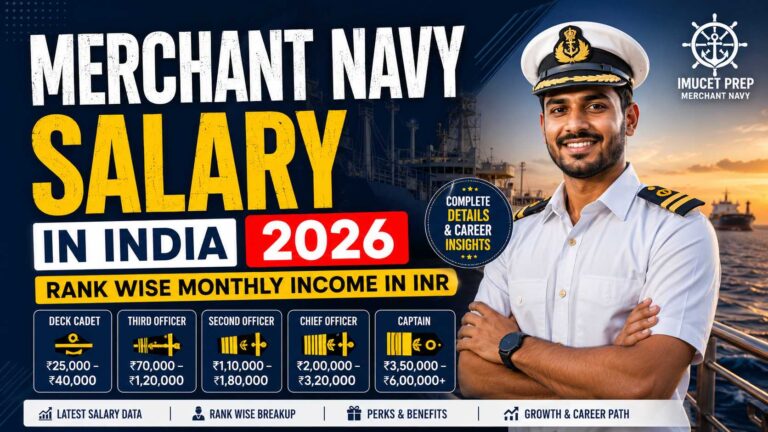
Understanding the merchant navy ranks salary structure is a massive motivation for IMUCET aspirants. The maritime industry offers a highly lucrative, tax-free income (depending on your country’s regulations) that scales rapidly as you climb the ranks.
Expected Salary Scale (Monthly Averages)
- Cadets (Deck/Engine): $500 – $1,500 (plus free training and boarding)
- Junior Officers (3rd Mate/4th Eng): $3,000 – $5,000
- Mid-Level Officers (2nd Mate/3rd Eng): $4,500 – $7,000
- Senior Officers (Chief Mate/2nd Eng): $8,000 – $12,000
- Top Command (Captain/Chief Eng): $12,000 – $20,000+
How Promotion Works
Advancing through the Ranks in Merchant Navy is entirely merit-based. You cannot buy a promotion; you must earn it through:
- Sea Time: You must complete a mandatory number of sailing months (usually 12 to 36 months) at your current rank.
- Competency Exams: Once your sea time is complete, you must pass rigorous written and oral examinations governed by STCW standards to secure your next license.
With dedication, a disciplined cadet can rise to the rank of Captain or Chief Engineer within 8 to 12 years of sailing.
Conclusion: A Team Effort
A multi-million dollar ship carrying cargo worth billions requires immense cooperation from every single individual on board. From the Captain navigating through a storm to the Wiper keeping the engine room clean, every team member plays a vital role in safely moving global trade from one port to another.
To echo the sentiments of many veteran mariners: While the Captain and Chief Engineer hold the supreme authority, a ship truly runs on the hard work of its specialized crew. A Chief Cook keeps the team motivated with excellent food, an ETO acts as a one-man army fixing critical technical failures, and a skilled Fitter holds the physical machinery together.
If you are ready to put on the uniform and command these prestigious Ranks in Merchant Navy, your journey starts with the right preparation. Join our leading IMUCET coaching center in Haryana today, clear your entrance exams with top scores, and set sail toward a brilliant, high-paying career at sea.
FOR MORE BLOG :